Skip to content
When Dental Implants Are the Right Choice: What Patients in Mascot Should Know
Dental implants and full-arch implants are modern, predictable ways to replace missing or failing teeth and restore confident, comfortable smiles. If you have teeth that can no longer be predictably saved, or you’re missing several teeth, implant treatment can protect your long-term oral health, function, and facial structure.
An implant is a small, biocompatible post placed into the jaw to act like a tooth root. It can support a single crown, a bridge, or a full-arch set of teeth. With local anaesthesia and, when appropriate, gentle sedation, the procedure is designed to be comfortable. Most people return to normal activities quickly, and any mild discomfort is typically managed with over-the-counter pain relief.
Many journeys to implants begin after a tooth is removed due to severe decay, injury, infection, or fractures. Planning for the replacement at the time of extraction can streamline your path back to a complete smile.
At Kita Dental in Mascot, our experienced team has guided many patients through general implant treatments and full-arch implant solutions. Our approach is gentle and patient-centred, with clear communication and meticulous planning so you know exactly what to expect at every step.
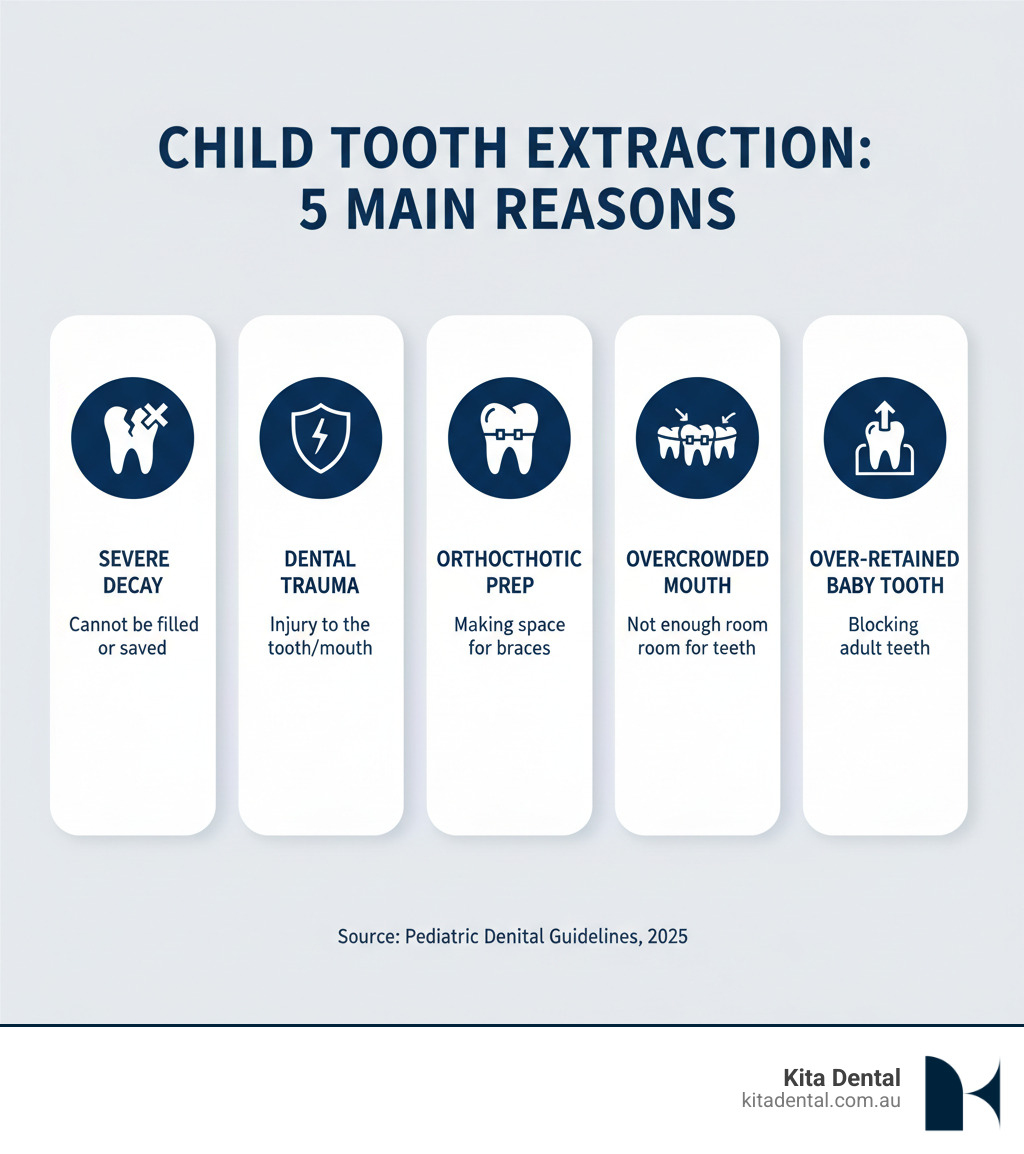
While the infographic above shows common reasons a tooth may need to be removed in children, adults often reach the point of needing implants for similar reasons: extensive decay, trauma, impacted or non-restorable teeth, or to support future orthodontic and restorative plans. If a tooth does need to be removed, planning an implant solution early helps you get back to a healthy, complete smile sooner.
Why You Might Need Dental Implants or Full-Arch Implants
We always aim to preserve natural teeth. When that’s no longer possible, a dental implant-based solution can be the most stable and long-lasting option to restore your bite and smile.
- Missing one or more teeth due to decay, cracks, or trauma.
- Teeth that are non-restorable or repeatedly infected.
- Advanced gum disease that has led to tooth loss.
- Trouble with loose or uncomfortable dentures, seeking a fixed full-arch option.
- Congenitally missing teeth or long-standing gaps affecting function and confidence.
- Strategic replacement to support orthodontic and restorative goals.
Good oral hygiene is the best defence against tooth loss and future complications. Healthy habits and regular check-ups help keep gums and existing teeth strong, and support the longevity of implants.
Learn more in our guides on Starting Dental Hygiene Early and Preventative Dental Care.
Understanding Tooth Loss and Bone Changes
After a tooth is removed, the jawbone in that area naturally shrinks over time because it no longer receives stimulation from a tooth root. Dental implants help preserve bone by transmitting chewing forces to the jaw, maintaining facial contours and stability. When a tooth cannot be saved, replacing it with an implant can be a proactive choice for long-term health and function. For more on tooth structure and why some teeth can’t be predictably restored, see our article on the 4 Layers of Teeth.
Full-Arch and Developmental Planning
If multiple teeth are missing or failing, a planned full-arch implant approach can restore an entire smile on as few as four to six implants per arch. Early assessment allows us to consider jaw space, bite, and aesthetics to prevent more complex issues later. This kind of thoughtful planning supports healthy development for families across life stages; for parents with growing children, broader smile and jaw guidance starts with preventive principles found in All About Preventive Orthodontics.
The Dental Implant Procedure: What to Expect
The idea of implant surgery can feel daunting, but at Kita Dental in Mascot it’s a well-planned, precise, and patient-centred process.

We begin with a comprehensive consultation, including 3D imaging where appropriate, to assess bone volume, gum health, and bite. This lets us plan implant positioning precisely and anticipate whether bone grafting or other adjunctive procedures might be beneficial. We’ll discuss options with you, including single-tooth, multi-tooth, or full-arch solutions, as well as anaesthesia and sedation choices.
Many implant journeys start with removing a tooth that can’t be saved. You can learn more about the general tooth extraction process here.
Simple vs. Surgical: Two Common Paths to Implant Placement
-
Single-tooth implants: When bone is healthy and access is straightforward, placement is usually quick and comfortable under local anaesthetic. In some cases, an implant can be placed at the same visit as an extraction.
-
Advanced or full-arch implant procedures: For people missing many teeth, we can use a planned approach (often called full-arch implants) to restore an entire jaw with a fixed bridge supported by several implants. Where bone is limited, adjunctive care such as bone grafting, sinus lift, or alternative implant strategies may be recommended. Small, dissolvable stitches are commonly used.
Ensuring Your Comfort and Safety
Your comfort comes first. We start with numbing gel before local anaesthetic so you barely feel the injection. You’ll feel pressure and vibration, but not sharp pain. For added relaxation, we offer nitrous oxide (“happy gas”), and we can discuss other sedation options if appropriate. Our team uses calm, clear communication throughout, so you always know what’s happening and can feel in control at every step.
Preparing for Implant Day & Caring for Yourself After
What you do before and after implant placement is just as important as the procedure itself. Good preparation and aftercare help healing and long-term success.

How to Prepare for Implant Surgery
- Use simple, reassuring expectations: the area will be made very numb, and you’ll feel pressure rather than pain.
- If sedation is planned, follow fasting instructions and arrange a support person to accompany you home.
- Take regular medications as advised by your dentist or GP; discuss any blood thinners well in advance.
- Avoid smoking and alcohol before and after surgery to support healing.
- Plan soft foods at home for the first few days and set aside time for rest.
Post-Procedure Aftercare: A Step-by-Step Guide
- Control bleeding: Bite down gently but firmly on the provided gauze for 15–30 minutes. Light oozing for the first 24 hours is normal. If needed, replace with fresh damp gauze and apply pressure again for 20 minutes.
- Manage discomfort: When the anaesthetic wears off, use over-the-counter pain relief (paracetamol or ibuprofen) as directed for adults in Australia, unless your GP or dentist advises otherwise. An ice pack on the cheek (15 minutes on, 15 off) can reduce swelling on the day of surgery.
- Soft diet: Choose yoghurt, mashed potatoes, smoothies, scrambled eggs, and lukewarm soups for a few days. Avoid hard, crunchy, or sticky foods while the site heals.
- Avoid suction and disturbance: For at least 24 hours, don’t use straws or rinse vigorously. Gentle sips and careful chewing away from the area help protect early healing.
- Keep the mouth clean: After 24 hours, begin gentle saltwater rinses (half a teaspoon of salt in a cup of warm water) after meals. Continue brushing and flossing other teeth, avoiding direct brushing on the surgical site until advised.
- Rest: Keep activity light for 24–48 hours. Sleep with your head slightly liftd the first night to help minimise swelling.
When to call us: Contact Kita Dental promptly if you experience severe pain not controlled by medication, excessive bleeding, fever, or increasing swelling. While uncommon, it’s important to get timely help so we can keep your recovery on track.
Long-Term Considerations: Implant Longevity and Future Smiles
Dental implants don’t just fill gaps—they help maintain bone and support your bite, speech, and facial harmony over the long term. Full-arch implant solutions can restore entire smiles when many teeth are missing or failing, offering a stable, fixed alternative to removable dentures.
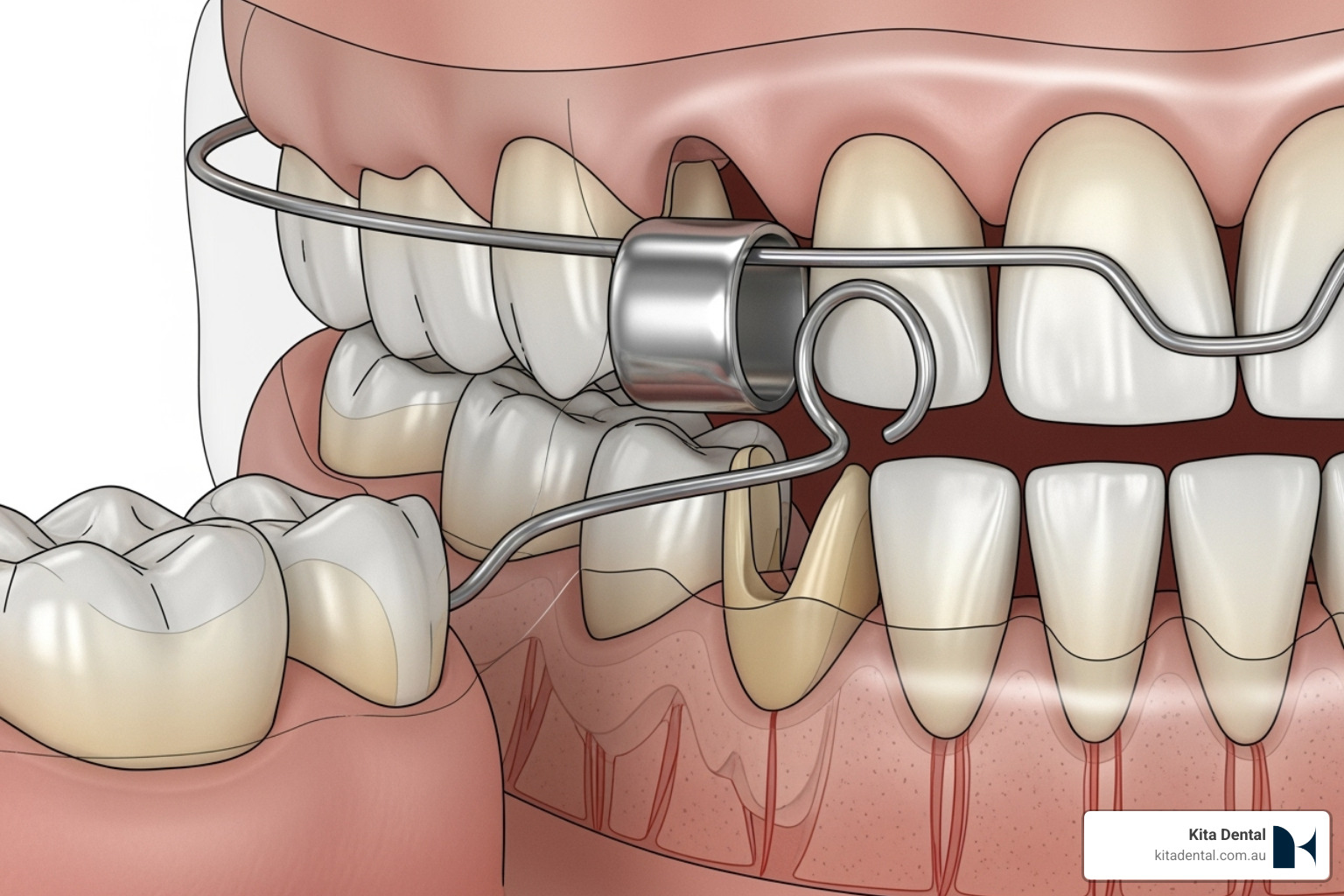
Unlike the space maintainers sometimes used for children (as pictured), implants act like replacement roots for adults, helping to preserve bone and keep neighbouring teeth from drifting. Thoughtful planning ensures your restoration looks natural and functions comfortably.
For longevity, maintain excellent oral hygiene, attend regular professional cleans, and follow your dentist’s guidance. If you clench or grind, a custom night guard can help protect your implant restorations. Early, preventive thinking benefits the whole family; for parents of younger children, explore our Preventative Orthodontic Treatment for Children to understand how smile development influences future oral health.
Frequently Asked Questions About Dental Implants
It’s natural to have questions when considering implants or full-arch solutions. Here are answers to common concerns we hear at Kita Dental in Mascot.
Myth vs. Truth: Are implants painful and bad for neighbouring teeth?
Myth: Implants are extremely painful.
Truth: With modern local anaesthesia—and sedation when appropriate—implant placement is designed to be comfortable. You may feel pressure and vibration, but not sharp pain. Most people manage any post-procedure soreness with over-the-counter medication.
Myth: Implants damage neighbouring teeth.
Truth: Properly planned implants actually help protect adjacent teeth by sharing biting forces and preventing shifting into empty spaces. They also help preserve the jawbone where teeth are missing.
When should I see a dentist about implants or a failing tooth?
Book a visit to Kita Dental if you notice any of the following:
- Persistent toothache or a tooth that has cracked or broken.
- A loose or missing tooth affecting your bite or confidence.
- Recurrent infections, swelling, or gum discomfort near a failing tooth.
- Difficulty chewing or speaking due to missing teeth or unstable dentures.
- You’re considering a fixed, full-arch solution to replace multiple failing teeth.
Regular Dental Visits help detect problems early and keep implants healthy long-term.
How long does it take to recover from implant treatment?
Recovery is typically straightforward.
- First 24–72 hours: Expect mild discomfort and some swelling. Keep activity light and stick to soft foods.
- First 1–2 weeks: Soft tissues settle significantly. Many people return to work within 1–2 days, depending on the procedure and their role.
- 3–6 months: The implant bonds with the jawbone (osseointegration). During this time, you may have a temporary tooth or bridge. Once integration is confirmed, the final crown or full-arch bridge is fitted.
Your Partner in Implant Dentistry in Mascot
Now you have a clear overview of general implant treatments and full-arch implant options—what they are, why they’re needed, and how recovery works. Implants can replace single or multiple missing teeth, help preserve bone, and restore confident function. With careful planning and follow-up care, they’re a reliable, long-term solution.
At Kita Dental in Mascot, Sydney, we take a gentle, compassionate approach to implant care that prioritises comfort and communication. Our experienced team delivers precise planning and supportive aftercare, seven days a week.
We’re here to help you regain a strong, natural-looking smile. As a trusted Family Dental Clinic serving the Mascot community, we’ll guide you from consultation to final restoration and beyond. For more information on our services, our Mascot Dental Surgery Complete Guide is an excellent resource.
Let’s plan a solution that fits your goals, lifestyle, and long-term oral health.