Takes less than 1 minute • Super funding supported


Durability and Longevity explained.
Two sets of teeth, why both stages exist, and the expected lifespan of each.
All on 4 treatment involves two distinct prostheses: a temporary set fitted within 24 hours of surgery, and a permanent final set fitted at 3–6 months once healing is confirmed.
The temporary prosthesis restores function during healing; the final prosthesis is the long-term result.
Understanding each stage and its materials is essential to making an informed treatment decision.
| When Fitted | 24 hours after surgery |
| Purpose | Restore functions and appearance during healing |
| Typical material | Acrylic / PMMA / 3D Resin Printed |
| Dietary restrictions | Soft diet required |
| Smile adjustment | Yes |
| Titanium bar | No |
| When Fitted | 3-6 months after surgery |
| Purpose | Long-term teeth |
| Typical material | Milled zirconia or acrylic titanium hybrid |
| Dietary restrictions | none |
| Smile adjustment | Limited |
| Titanium bar | Yes |
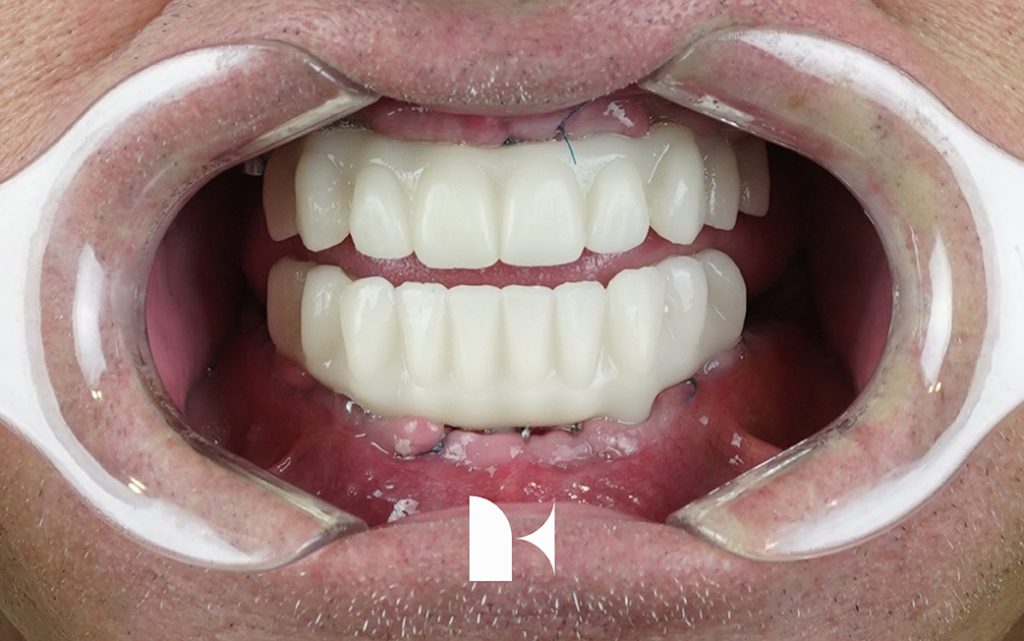
| When Fitted | 24 hours after surgery |
| Purpose | Restore functions and appearance during healing |
| Typical material | Acrylic / PMMA / 3D Resin Printed |
| Dietary restrictions | Soft diet required |
| Smile adjustment | Yes |
| Titanium bar | No |
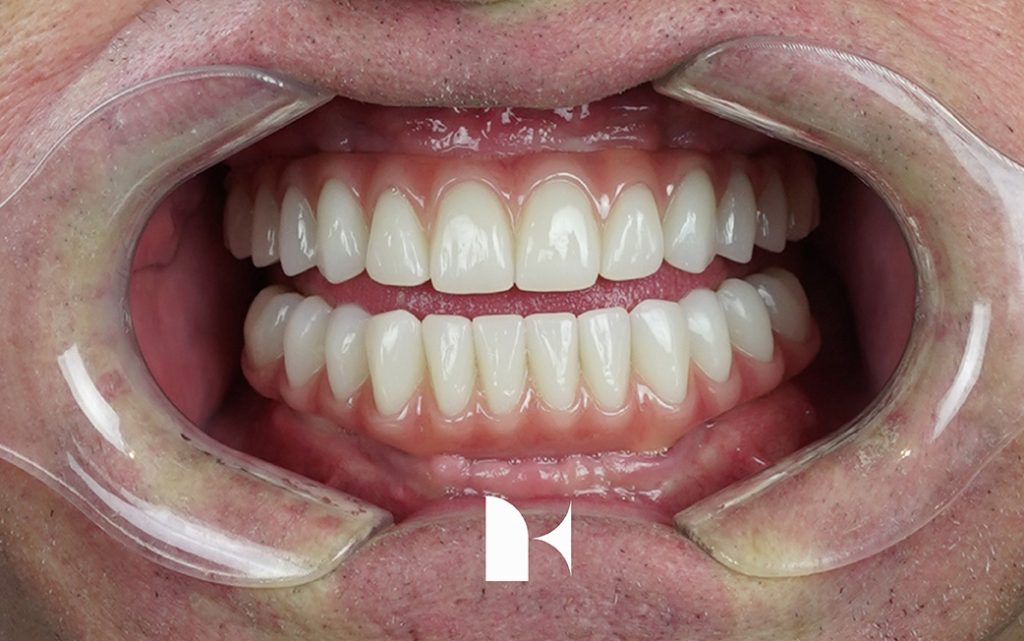
| When Fitted | 3-6 months after surgery |
| Purpose | Long-term teeth |
| Typical material | Milled zirconia or acrylic titanium hybrid |
| Dietary restrictions | none |
| Smile adjustment | Limited |
| Titanium bar | Yes |
Temporary All on 4 prostheses are made from either 3D-printed ceramic-filled resin or PMMA acrylic.
Both are lightweight materials designed to minimise pressure on healing implants during the 3–6 month healing period.
The choice between them depends on your priorities: cost, durability and aesthetics.
3D-printed resin is fabricated before surgery from your planned smile design. It’s lightweight to protect healing implants and ready to fit on surgery day.
• Lower fracture resistance than PMMA
• Less natural appearance than PMMA
• Most affordable option
You’ll wear this for 3–6 months during healing, then transition to your final teeth. It serves the purpose well if cost is your priority.
PMMA is stronger and more durable than resin. It’s also fabricated before surgery from your planned smile design and is ready to fit on surgery day.
• Stronger fracture resistance
• Closely resembles final teeth
• Higher cost than resin
Most people find PMMA looks and feels natural throughout the 3–6 month healing phase. Better for aesthetics and durability if that matters to you.
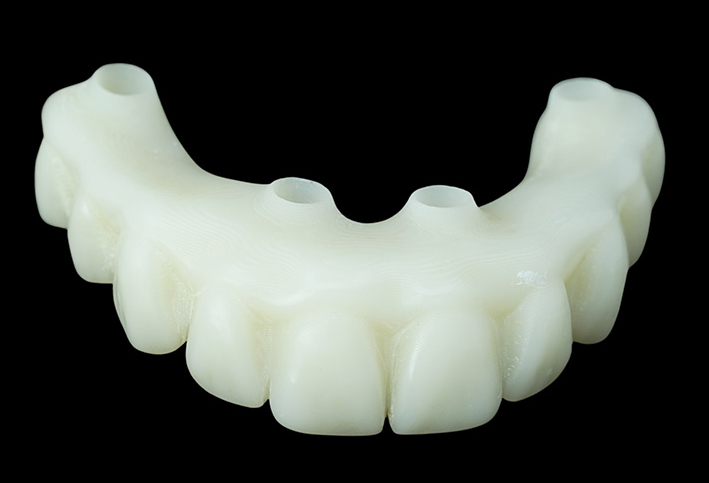
3D-printed resin is fabricated before surgery from your planned smile design. It’s lightweight to protect healing implants and ready to fit on surgery day.
• Lower fracture resistance than PMMA
• Less natural appearance than PMMA
• Most affordable option
You’ll wear this for 3–6 months during healing, then transition to your final teeth. It serves the purpose well if cost is your priority.
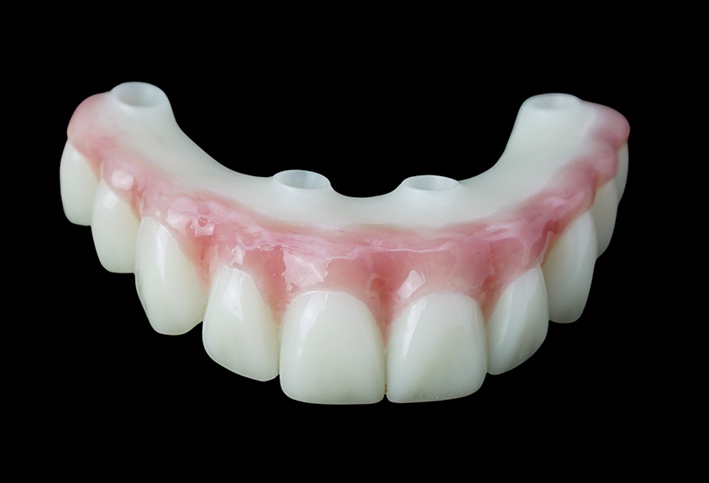
PMMA is stronger and more durable than resin. It’s also fabricated before surgery from your planned smile design and is ready to fit on surgery day.
• Stronger fracture resistance
• Closely resembles final teeth
• Higher cost than resin
Most people find PMMA looks and feels natural throughout the 3–6 month healing phase. Better for aesthetics and durability if that matters to you.
Your final teeth are fitted about 3–6 months after surgery, once implants have fully integrated with bone. This is your permanent, long-term set of teeth.
Both materials are durable, long-term solutions.
The choice depends on your priorities:
• Clinical factors — bite force, jaw dimensions, and bone support
• Aesthetics — translucency, colour matching, and smile design
• Budget — full cost transparency discussed at consultation
• Repairability — preference for individual tooth repair vs full durability
Acrylic-hybrid consists of a precision-milled titanium frame with individual acrylic/composite teeth. Individual teeth can be replaced without replacing the entire prosthesis.
Advantages:
Natural appearance — resembles tooth enamel
Biocompatible — well-tolerated by gums and bone
Lighter than zirconia
Individual teeth can be repaired or replaced
Longevity: 10–20+ years
Trade-offs:
Acrylic surfaces can stain or wear over time
Requires more maintenance than zirconia
Zirconia is a strong, tooth-coloured ceramic that’s digitally milled for precision and strength.
Advantages:
Natural appearance — resembles tooth enamel
Surface resists staining
Biocompatible — well-tolerated by gums and bone
Longevity: 20+ year clinical track record
Trade-offs:
Heavier than acrylic-hybrid
Repair cost ($9,000–$12,000 AUD per arch); typically requires full prosthesis replacement
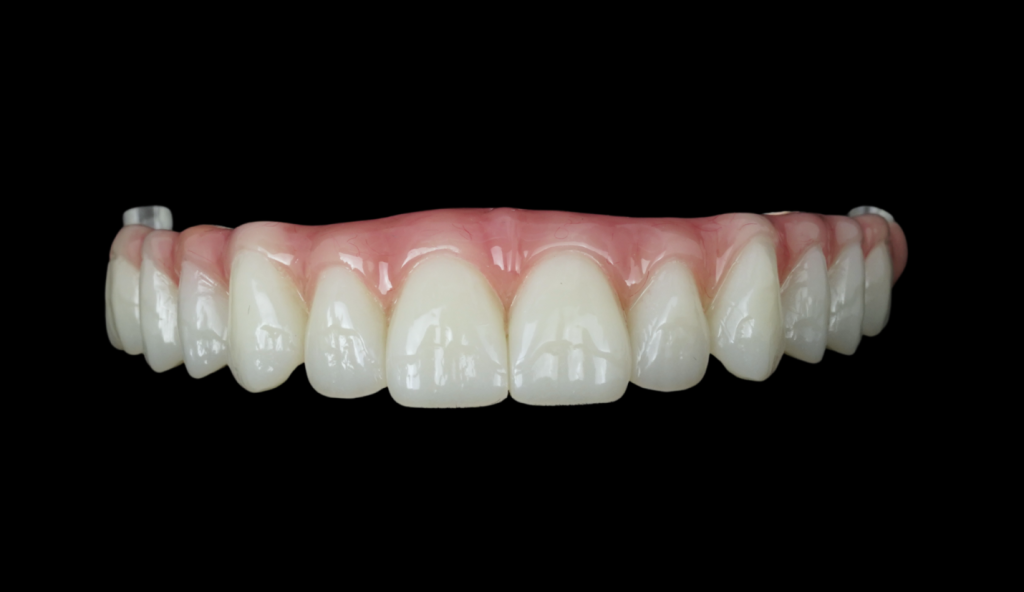
Acrylic-hybrid consists of a precision-milled titanium frame with individual acrylic/composite teeth. Individual teeth can be replaced without replacing the entire prosthesis.
Advantages:
Natural appearance — resembles tooth enamel
Biocompatible — well-tolerated by gums and bone
Lighter than zirconia
Individual teeth can be repaired or replaced
Longevity: 10–20+ years
Trade-offs:
Acrylic surfaces can stain or wear over time
Requires more maintenance than zirconia
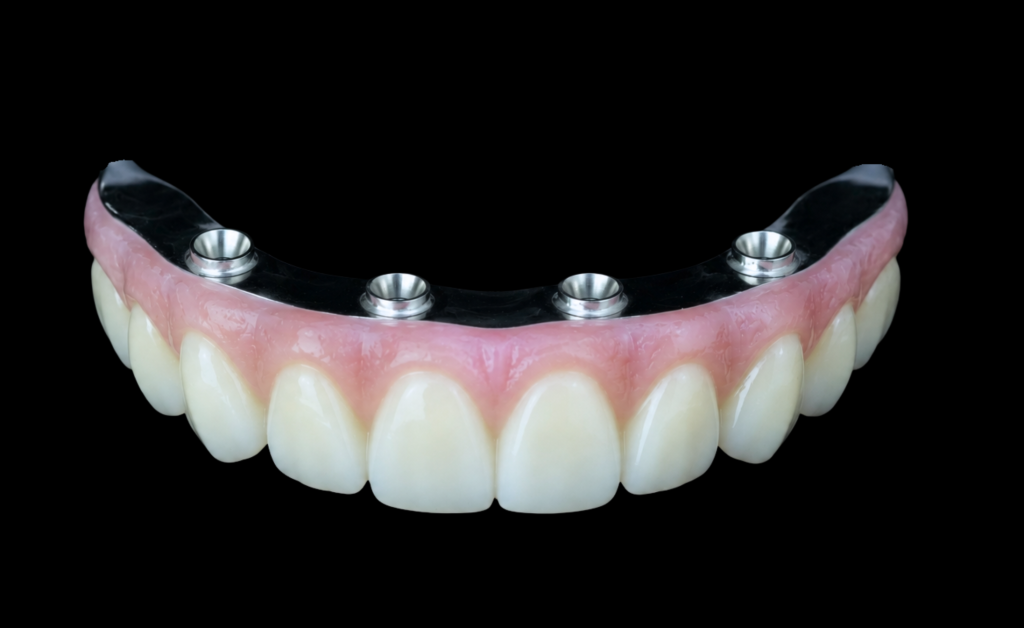
Zirconia is a strong, tooth-coloured ceramic that’s digitally milled for precision and strength.
Advantages:
Natural appearance — resembles tooth enamel
Surface resists staining
Biocompatible — well-tolerated by gums and bone
Longevity: 20+ year clinical track record
Trade-offs:
Heavier than acrylic-hybrid
Repair cost ($9,000–$12,000 AUD per arch); typically requires full prosthesis replacement
Every final set of teeth contains a custom titanium bar designed from your exact
implant positions. Precise fit, even bite force distribution, and long-term durability.
The implant fixtures (the titanium screws) are generally the longest-lasting component of an All on 4 result, often functioning for years with good maintenance.
The screws are placed into the jawbone. They are not visible and sit entirely beneath the gum line.
At Kita Dental, we use Straumann BLX and Neodent implant systems. Both are supported by published clinical research, although the available follow-up periods vary between specific implant models and treatment types.
More broadly, a systematic review of dental implant studies reported an estimated implant survival rate of approximately 96.4% after 10 years.[1] This figure applies to dental implants generally and does not guarantee the outcome of an individual treatment.
With successful bone integration, good oral hygiene and regular professional maintenance, dental implants are designed to provide long-term function.
The final prosthesis is the visible set of replacement teeth attached to the implants. Because it is exposed to everyday chewing forces, it is more likely than the implants themselves to require maintenance, repair or replacement over time.
How long it lasts depends on the material used, your bite, oral hygiene and ongoing care. Wear, staining or occasional chipping may occur, and some components may need attention sooner than others.
For definitions of all implant components read more here.
[1] Howe MS, Keys W, Richards D. Long-term (10-year) dental implant survival: a systematic review and sensitivity meta-analysis. Journal of Dentistry. 2019;84:9–21. doi:10.1016/j.jdent.2019.03.008.
All on 4 prostheses made from either Zirconia or PMMA acrylic are designed to closely match natural teeth in colour, shape, and proportion. At Kita Dental, most patients cannot distinguish their provisional PMMA teeth from natural dentition. The final set is designed using a detailed smile design process calibrated to each patient’s facial features.
All on 4 teeth are designed to for long-term wear, however maintenance and repair over time is expected. Zirconia teeth may need full replacement if a section fractures, while acrylic-hybrid teeth often allow individual tooth repair without replacing the whole bridge. Regular review appointments help catch and address wear early.
Free · no obligation
Not sure if you qualify? Take our free online assessment and our team will review your responses personally and contact you
Takes less than 1 minute • Super funding supported