
Additional Implant Support for a Full set of Fixed Teeth.
If you’ve been told you need more support than a standard implant treatment can offer because of bone density, bite force, or the size of your jaw, then All on 6 may be the option your dentist recommends. It replaces a full set of missing or failing teeth with a fixed set of new teeth, supported by six dental implants instead of four.
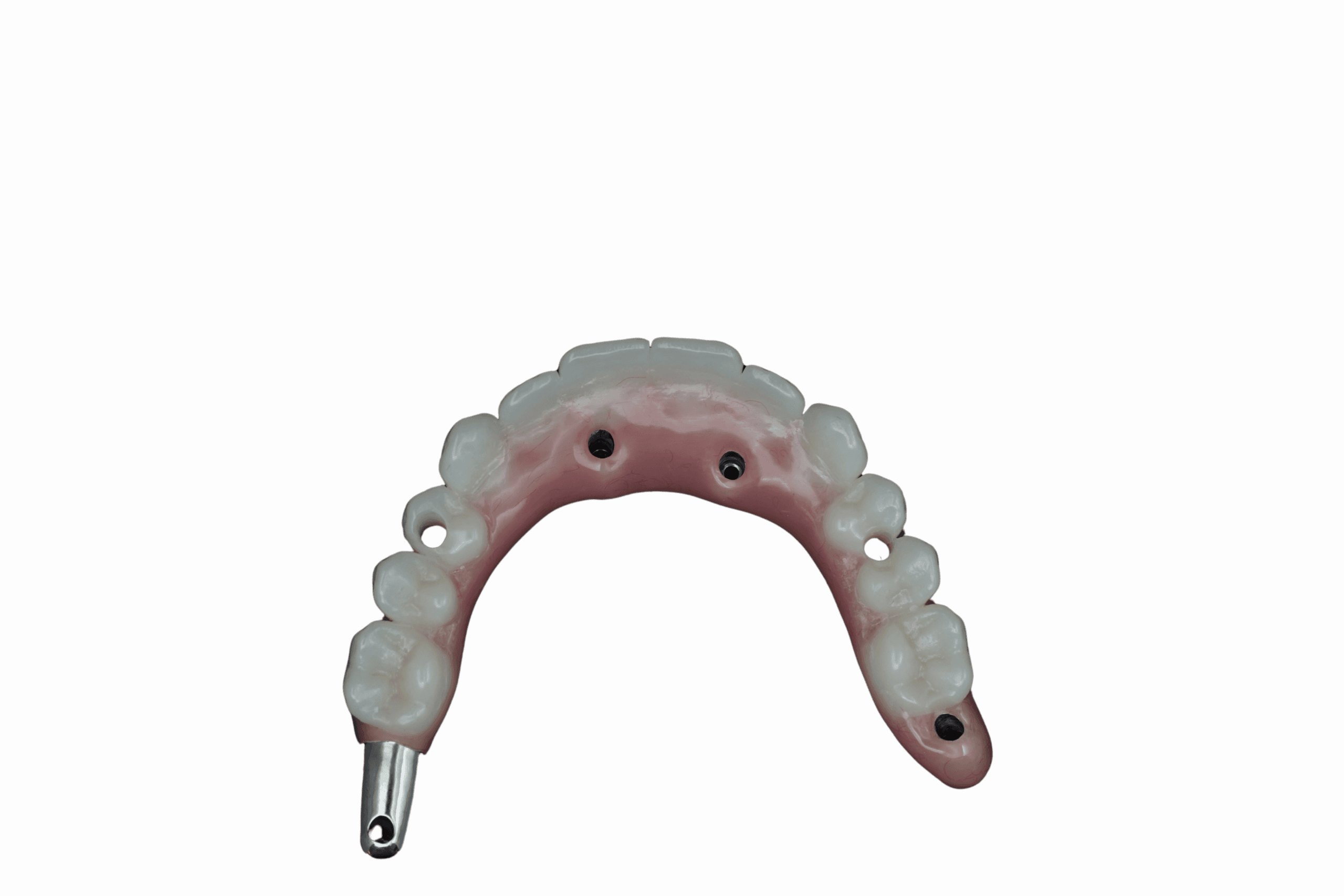
All on 6 is an implant treatment. Six implants are placed in the jawbone, and a fixed, non-removable set of replacement teeth is attached to them. Like other full-mouth treatments, it’s designed for people who are missing most or all of their teeth, or who have failing teeth that need to be replaced.
The right number of implants for your treatment isn’t a matter of preference, rather it’s determined by a clinical assessment of your jaw anatomy, bone quality, and the support your particular case needs.
Using two extra implants gives the new teeth more support and helps spread the pressure more evenly. This can be especially helpful in certain situations.
Lower bone density
Bone density varies from person to person, and the upper jaw is generally softer than the lower jaw. Where bone is less dense, spreading the load across six implants rather than four can reduce the force carried by each one.
Higher bite forces
People who clench or grind place greater pressure on their teeth. Additional implants help distribute that pressure across a wider base of support.
A larger or wider jaw
A physically larger arch spans a greater distance. More implants can reduce the length of unsupported span between anchor points.
Reducing cantilever length
A cantilever is the part of the fixed teeth that extends beyond the last implant, a little like the end of a diving board. The longer that section, the more leverage it places on the implants. Positioning an implant further back can shorten the cantilever and help balance the load.
Not necessarily. More implants don’t automatically produce a better result. What matters is whether the number and position of implants are appropriate for the individual.
In some cases, four well-positioned implants can provide stable support; in others, six are more appropriate. Using fewer implants where clinically suitable can also mean a less invasive procedure and a simpler recovery.
Research into full-mouth implant treatment also shows that outcomes need to be considered alongside factors such as implant survival, bone levels and biological or mechanical complications and not implant number alone.

Fixed restoration
All on 6 uses a fixed set of teeth that stays securely in place and cannot be removed at home. Having six implants helps spread the pressure evenly and support the jawbone over time.
Daily care
Like natural teeth, All on 6 needs regular care. This includes daily brushing and cleaning around the implants, as well as routine dental check-ups.
How long does it last?
Dental implants are designed to be a long-term solution. Studies report that around 96% of dental implants are still in place after 10 years. However, results vary from person to person. The fixed teeth attached to the implants can also last more than 10 years with good care, although they may eventually need repair or replacement.
[1] Malo P, de Araújo Nobre MA, Lopes A, Moss SM, Molina Perez GJ. (2019). Immediate loading (Same Day Teeth) concept with All-on-4: retrospective clinical report. Clinical Implant Dentistry and Related Research, 21(4), 681–695. PMID: 31304663. https://pubmed.ncbi.nlm.nih.gov/31304663/
[2] Papaspyridakos P, Chen CJ, Singh M, Weber HP, Gallucci GO. (2021). Success criteria in implant dentistry: A systematic review. Journal of Dental Research. PMID: 21940744. https://pubmed.ncbi.nlm.nih.gov/21940744/
Yes, All on 6 typically involves a higher investment due to the additional implants and surgical time required. All on 4 starts from $23,500, with All on 6 priced individually based on your treatment plan. Exact costs are confirmed after a consultation.
A dentist may recommend All on 6 when extra support is needed because of factors like jawbone strength, bite pressure, jaw size, or the shape of the new teeth. It’s based on your individual needs rather than personal preference.
The All on 6 procedure generally involves placing two additional implants, which can mean a longer procedure. Where fewer implants are clinically appropriate, that typically means a less invasive treatment and simpler recovery.
