

Advanced treatment for Dental Implant cases that go beyond the standard approach.
Some implant cases are less straightforward than others.
An All on 4 dental implant case may be considered more complex when certain anatomical, medical, or treatment-related factors make standard implant placement more challenging.
This may include:
Having a complex case does not automatically mean implant treatment is not possible. In many situations, treatment may still be achievable using additional planning, different implant techniques, or staged treatment approaches.
Disclaimer: Complex implant cases at Kita Dental are assessed and treated by Dr Chin Kent Boon (DMD, MSc Oral Implantology | Registration Number: DEN0002236399). Dr Kent has undertaken advanced training in complex implant procedures including zygomatic implant placement, pterygoid implant placement, and full-arch rehabilitation in compromised bone. Patients presenting with significant bone loss, failed implants, or previous unsuccessful treatment are assessed individually. Detailed CBCT imaging and a structured treatment plan are completed before any recommendation is made.
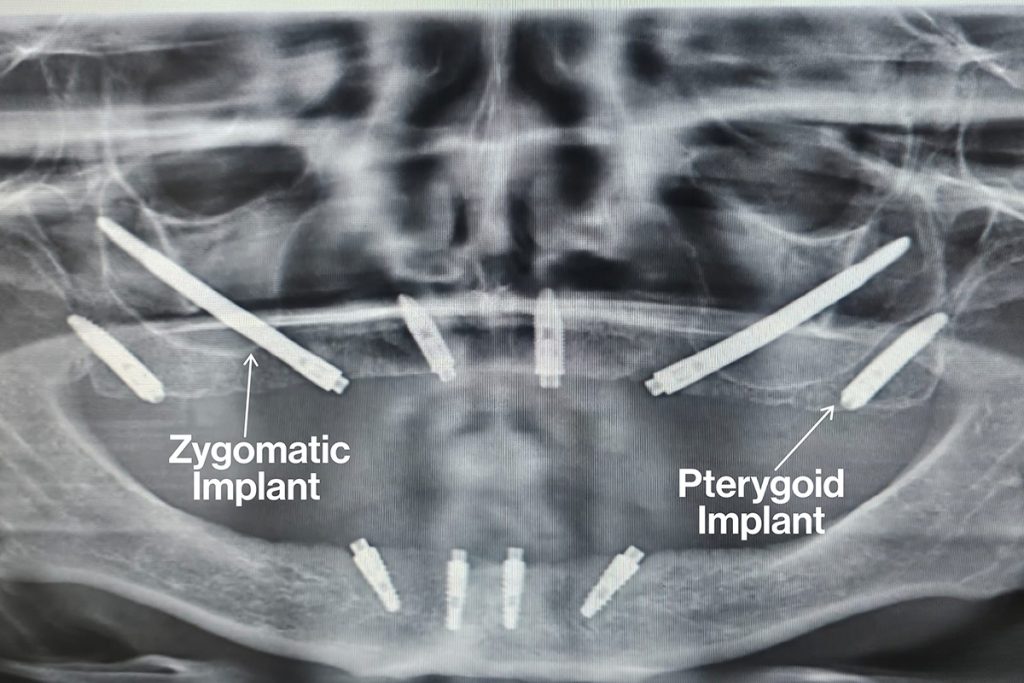
If you have severe bone loss in your upper jaw, standard dental implants sometimes may not be an option. Zygomatic implants offer another way. Instead of anchoring into your jawbone, they anchor into your cheekbone, which stays strong even when the jaw has weakened.
When your upper jaw has lost significant bone, zygomatic implants can make full-arch restoration possible. For many, this approach is simpler and less invasive than extensive bone grafting.
Zygomatic implants aren’t a standard procedure, but in suitable cases, they can restore function and confidence without years of preparatory treatment.
What are they?
Zygomatic implants are longer dental implants that anchor into the zygoma—the cheekbone, rather than the upper jawbone. Because the cheekbone is dense and unaffected by tooth loss or denture wear, it can provide stable support for an implant-supported restoration even when the jaw has significant bone loss.
Why the cheekbone?
Severe upper jawbone atrophy is a common consequence of prolonged tooth loss or full denture wear. The jaw resorbs over time because it’s no longer receiving the stimulation of chewing. The cheekbone, by contrast, remains relatively unaffected by tooth loss and typically retains adequate bone density and volume making it a reliable alternative anchor point.
Surgical placement
Zygomatic implant placement requires careful anatomical planning via 3D imaging to map the cheekbone, sinuses, eye socket, and other critical structures. The surgical approach accesses the cheekbone from within the mouth, positioning the implant at an angle that engages both cheekbone and upper jaw bone where available. Like other implants, a healing and integration period follows before the final restoration is placed.
Restoration options
Once integrated, zygomatic implants typically support a fixed, full-arch restoration (similar to All on 4 or All on 6 configurations) or other implant-supported prostheses, depending on your anatomy and treatment goals.
This treatment may be worth exploring if you:
• Have experienced severe bone loss in the upper jaw
• Have been told elsewhere that dental implants are not possible for you
• Have worn full dentures for an extended period
• Have reduced bone height in the sinus area
• Would prefer to avoid or are not suitable for extensive bone grafting
If any of these apply to you, zygomatic implants may represent a viable path forward. Suitability can only be determined through a clinical assessment.
Zygomatic implant treatment is not offered widely in Australia. It demands a level of surgical training, anatomical knowledge, and pre-operative planning that goes well beyond standard implant placement.
Dr Kent’s advanced implant training includes zygomatic implant procedures, allowing us to assess and treat complex cases.
If standard implants won’t work in the front of your upper jaw, pterygoid implants offer another option. They anchor into dense bone at the back and sides of your jaw—areas that stay strong even when the front has significant bone loss.
When your upper jaw has lost substantial bone, pterygoid implants can make full-arch restoration possible. For some, this approach is simpler and less invasive than extensive bone grafting.
Why the posterior jaw?
When the upper teeth have been missing for a long time, the bone that once supported them can gradually shrink. In some people the bone further back in the jaw remains stronger and more suitable for supporting an implant.
Pterygoid implants use this area as an additional anchor point when there is not enough suitable bone in the usual implant position.
Surgical placement
Before treatment, a 3D scan is used to assess the jawbone, nearby sinuses, and the safest position for the implant. Pterygoid implants must be placed at a certain angle into the bone, at the back of the upper jaw. Because this area is more complex, the procedure requires advanced planning and surgical experience.
Pterygoid implants may help if you have:
• Significant bone loss in the front of your upper jaw
• Health factors or previous attempts that make bone grafting impractical
• An enlarged sinus that’s reduced bone available for standard implant placement
• Previous bone grafts that didn’t restore enough bone for standard implants
• A preference to skip or minimise bone grafting and extended preliminary procedures
Some cases work best with a combination approach such as pterygoid implants alongside other advanced techniques, depending on your specific anatomy.
Pterygoid implant placement demands precise anatomical knowledge of posterior upper jaw structures and the surgical experience to place implants safely in this region. Dr Kent’s training includes pterygoid implant techniques, allowing assessment and treatment of anatomically complex cases that require posterior jaw anchoring.
Every pterygoid implant case begins with detailed imaging review and careful surgical planning. The planning stage determines the feasibility, positioning, and integration with other components of your treatment plan.
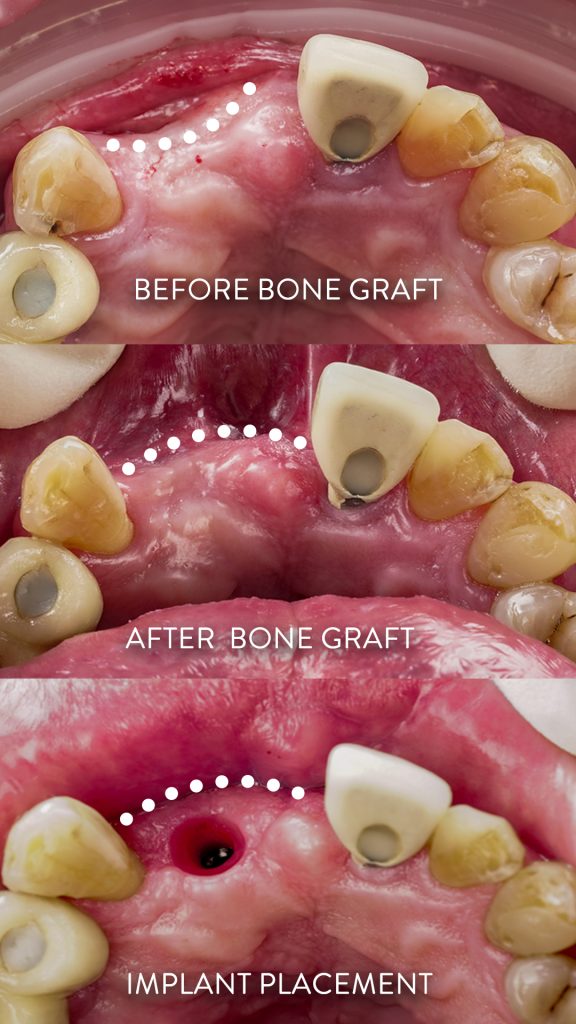
For a dental implant to succeed, it requires a stable foundation. That foundation is bone and when there isn’t enough of it, bone grafting is how we rebuild it.
Bone loss is more common than most people realise. It can occur gradually after tooth loss, as a result of gum disease, infection, or trauma, or simply through years of denture wear. Some people also have naturally thinner jawbone structure that requires additional support before implant placement is possible.
This doesn’t mean implants are out of reach. It means the groundwork needs to be laid properly first.
Depending on the situation, bone material may come from:
Over time, the graft integrates with the jawbone and may help improve implant support.
Different grafting approaches may be considered depending on your anatomy, including:
Healing time varies between individuals and depends on the type of graft performed.
Bone loss is one of the most common reasons implant treatment becomes more complex.
When teeth are missing for a long period, the jawbone naturally shrinks because it is no longer receiving stimulation from chewing.
In some situations, there may not be enough bone volume to support standard implant placement.
Depending on your anatomy, treatment options may include:
The appropriate option depends on the amount and location of bone loss.
Bone grafting is not a procedure every implant provider offers — and not every provider who offers it has the surgical experience to handle it well.
Dr Kent’s advanced training includes complex grafting procedures, which means those who have been told their bone loss makes implants impossible are often still candidates for treatment in our hands.
If you’ve been told bone loss is a barrier to implants, we’d encourage you to come in for a second opinion before closing the door on treatment.
Potential risks for Dental Implants include swelling, bruising, and discomfort during healing, infection at the implant site if post-operative care instructions aren’t followed, and temporary changes in sensation due to nerve irritation, which typically resolves over time. Dental Implants are a surgical procedure and we believe every person deserves a clear picture of what that involves.
In some cases, the body may not fully integrate with the implant, which can result in implant failure. These outcomes are not common, but they are possibilities we take seriously. Before treatment begins, we walk through every relevant risk, benefit, and alternatives with you.
Yes, in many cases a history of gum disease doesn’t automatically exclude you from All on 4 dental implants, but active or uncontrolled gum disease generally needs to be treated and stabilised first. During your assessment, we evaluate your gum health, bone condition, and overall oral hygiene to determine whether you’re ready for treatment now or need a period of management beforehand. If you do proceed, we’ll put a long-term maintenance plan in place, and patients with a history of gum disease are typically monitored more closely after treatment to help protect the result.
If an Implant needs to be removed, we’ll always begin with an assessment first. This examines bone density, health factors, and the cause of failure. Depending on findings, the process may include: removal and infection management, bone grafting to restore volume, a healing period, and systemic factor review before any replacement is considered.
Should your Dental Implant require re-implanting, it’s important to understand that the site often heals well and can support a new implant within months. Some may require bone grafting first or may not be suitable for replacement. This is determined by clinical examination.
All on 4 treatment may not be suitable for everyone, and if it is not appropriate for your situation, your dentist will explain why and discuss alternative options where relevant. Depending on your circumstances, these may include alternative implant approaches, staged treatment, removable dentures, or other treatment options. The aim is to recommend treatment that is clinically appropriate for you, not simply what is possible.
Free · no obligation
Not sure if you qualify? Take our free online assessment and our team will review your responses personally and contact you
Takes less than 1 minute • Super funding supported