

Advanced treatment for Implant cases that go beyond the standard approach.
If you’ve lost a lot of bone in your upper jaw, you may have been told that regular dental implants aren’t an option for you. Zygomatic implants offer another way forward. Instead of anchoring into the jawbone, they anchor into the cheekbone, which is a much stronger, denser bone that stays solid even when the jaw has worn away.
Zygomatic implants are longer dental implants that anchor into the zygoma (cheekbone) rather than relying entirely on the upper jaw. They are typically used when there isn’t enough upper jawbone to securely support standard dental implants.
After teeth have been missing for a long time, the upper jawbone can gradually shrink due to a lack of stimulation from chewing. The cheekbone generally remains dense and strong, providing a stable alternative for supporting implants when there is significant bone loss in the upper jaw.
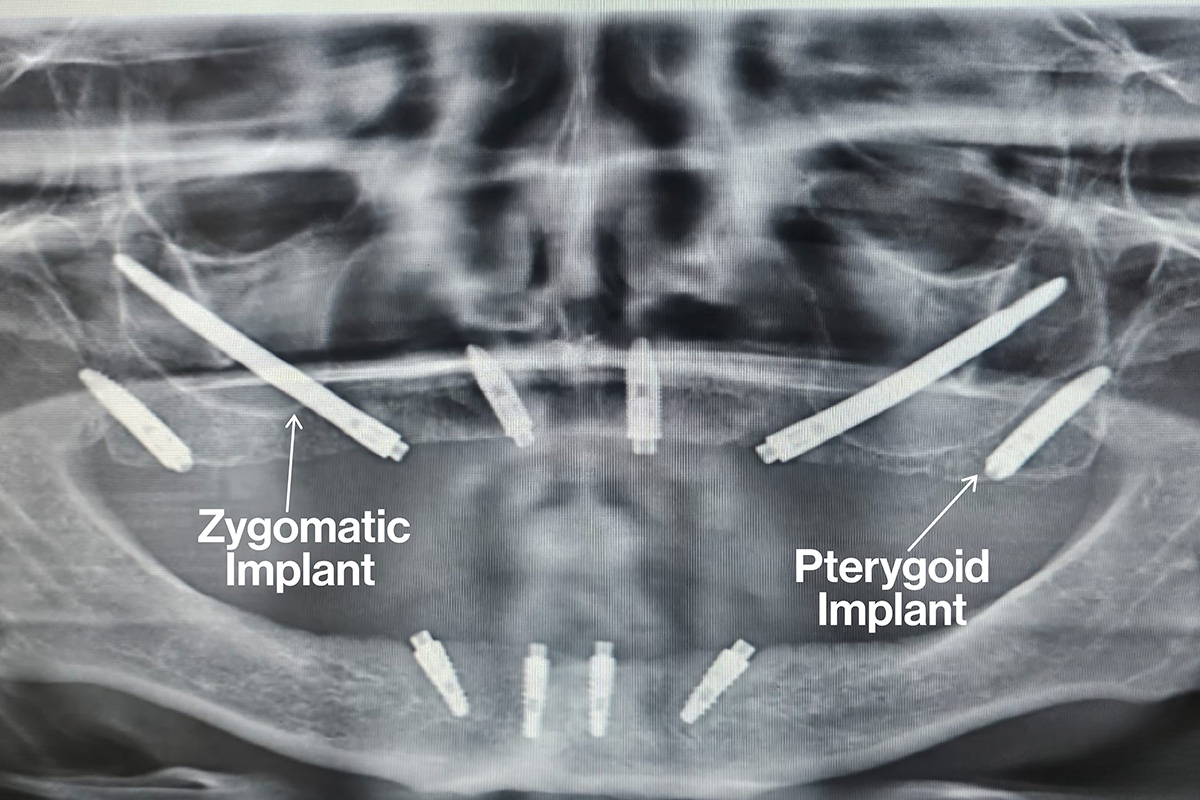
Before any surgery, your dentist maps out the cheekbone, sinuses, eye socket, and other nearby structures using a detailed 3D scan. This lets them plan exactly where each implant needs to go.
The implants themselves are placed through the mouth at an angle that reaches up into the cheekbone, while also engaging the jawbone where there’s still enough of it to help. As with other dental implants, there’s a healing period afterwards, during which the implant fuses with the bone, before your final teeth are fitted.
Your dentist may consider zygomatic implants where a situation includes factors such as:
These factors point to when zygomatic implants may be worth investigating, however suitability is a clinical decision, made by your treating dentist based on a full assessment of your bone structure, sinus anatomy, and overall oral health, not something determined by personal preference alone.
Zygomatic implant treatment isn’t widely offered in Australia. It requires a level of surgical training, anatomical knowledge, and pre-operative planning that goes well beyond standard implant placement.
Dr Kent’s advanced implant training includes zygomatic implant procedures, allowing us to assess and treat complex cases that may not be suitable for standard implant treatment elsewhere.
Disclaimer: Complex implant cases at Kita Dental are assessed and treated by Dr Chin Kent Boon (DMD, MSc Oral Implantology | Registration Number: DEN0002236399). Dr Kent has undertaken advanced training in complex implant procedures including zygomatic implant placement, pterygoid implant placement, and full-arch rehabilitation in compromised bone. Patients presenting with significant bone loss, failed implants, or previous unsuccessful treatment are assessed individually. Detailed CBCT imaging and a structured treatment plan are completed before any recommendation is made.
Implant treatment is a surgical procedure, and we believe every person deserves a clear picture of what that involves. Potential risks include swelling, bruising, and discomfort during healing; infection at the implant site if post-operative care instructions aren’t followed, and temporary changes in sensation due to nerve irritation, which typically resolves over time. In rare cases, the body may not fully integrate with the implant, which can result in implant failure. These outcomes are not common, but they are possibilities we take seriously. Before treatment begins, we walk through every relevant risk, benefit, and alternative with you.
For many patients, yes. Anchoring into the cheekbone can reduce or remove the need for bone grafting. Some patients may still need grafting in combination with zygomatic implants, depending on their anatomy. This will be discussed with you at your consultation.
Assessment comes first. Examining bone, health factors, and the original failure cause. Depending on findings, the process may include: removal and infection management, bone grafting to restore volume, a healing period, and systemic factor review before any replacement is considered.
Every smile journey is different. Let’s find yours.