How Are All on X Dental Implants Different from Dentures?
The main difference is that All on X dental implants are a fixed set of teeth anchored to four titanium implants placed in the jawbone, while dentures are removable and rest on top of the gums. All on X teeth stay in place and are cleaned in the mouth; dentures are taken out for cleaning and at night. Beyond that, the two options differ in stability, effect on the jawbone, cost, and who they suit. Both are well-established ways to replace a full arch of teeth, and the right choice depends on your individual situation.
What is All on 4?
All on X replaces a full arch of teeth using four implants — two placed at the front of the jaw and two angled towards the back. Once the implants have fused with the bone (a process called osseointegration), a fixed bridge of teeth is attached. The angled placement is designed to make good use of available bone, which can sometimes avoid the need for bone grafting. The result is a set of teeth that does not come out and is cared for in the mouth.
What are dentures?
Dentures are removable replacement teeth set into a gum-coloured base. A full denture replaces all the teeth in an arch and rests on the gums, held by suction, the shape of the ridge, and sometimes denture adhesive. They are taken out for cleaning and usually overnight. Dentures are a long-established, non-surgical option and remain a sensible choice for many people particularly where surgery isn’t suitable or where a lower upfront cost is a priority.

The key differences explained
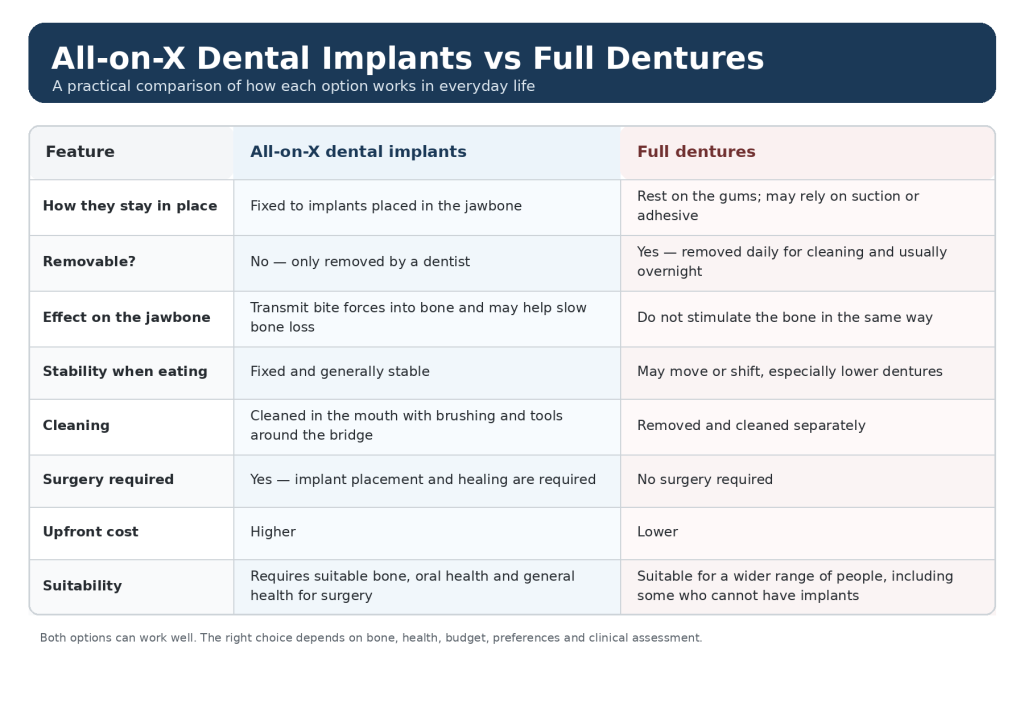
Fixed vs removable. This is the biggest practical difference. All on X teeth are fixed in place; dentures are removable. Many people who choose implants do so because they prefer not to take their teeth out, and find a fixed bridge more secure for eating and speaking. Others prefer the simplicity and lower cost of a removable denture.
Effect on the jawbone. When teeth are lost, the jawbone that supported them tends to shrink over time. Because implants transmit chewing forces into the bone, they can help slow this bone loss in the treated area. Dentures rest on the gum and don’t stimulate the bone in the same way, so bone can continue to shrink underneath, which is one reason dentures sometimes need relining or remaking over the years.
Stability and comfort. A fixed, implant-supported bridge stays put. Dentures, especially lower ones can move during eating or speaking, which some people find takes getting used to. That said, a well-made denture suits many people very comfortably.
Cleaning and care. Implant-supported teeth are cleaned in the mouth, with brushing plus interdental brushes, super floss or a water flosser around the bridge. Dentures are removed and cleaned separately. Both require good daily hygiene and regular dental visits.
Surgery. All on X involves a surgical procedure and a healing period of several months. Dentures do not require surgery and can usually be provided more quickly.
Cost. Dentures generally have a lower upfront cost. All on X is a larger investment, though it is designed to be long-lasting and carries the bone-preservation benefit. Treatments with a functional benefit may attract a rebate under “major dental” health-fund cover, check your entitlements with your fund.
Which option is right for you?
There is no single “better” option, it depends on your circumstances. Factors that influence the choice include how much healthy jawbone you have, your general health and suitability for surgery, your budget, and whether you prefer fixed or removable teeth. Some people who don’t have enough bone for standard implants may still have options such as bone grafting or alternative implant approaches, while others find a denture is the most practical and comfortable solution for them. A consultation with 3D imaging is the best way to weigh up which suits you.
Pros and cons at a glance
All on X— potential advantages: fixed in place, no adhesives, generally stable for eating and speaking, helps slow jawbone loss, designed to be long-lasting.
All on X considerations: involves surgery and a healing period, higher upfront cost, requires sufficient bone and general health, carries surgical risks.
Dentures — potential advantages: non-surgical, lower upfront cost, suitable for a wider range of people, quicker to provide, removable for cleaning.
Dentures considerations: can move or feel less secure, don’t stimulate the bone, may need relining or remaking over time, some people dislike removing them.
References
- Dental Board of Australia / AHPRA — Guidelines for advertising a regulated health service. ahpra.gov.au
- Australian Dental Association — patient information on dentures and dental implants. ada.org.au
- healthdirect (Australian Government) — Dentures and Dental implants. healthdirect.gov.au
Written by Dr Chin Kent Boon
10 January 2026
All on X treatments at Kita Dental are led by Dr Kent, Principal Dentist and Implantologist, who holds a Master of Oral Implantology. Kita Dental is a dental clinic located in Mascot, NSW, with a strong focus on dental implants.
This article is general information only and is not a substitute for personalised advice from a registered dental practitioner. Outcomes vary from patient to patient.