Dental Implant Terms Explained
When you’re researching dental implants, the terminology can be overwhelming. This glossary covers the words and phrases you’re likely to come across — from your first consultation through to treatment and aftercare.
Anatomy & Jaw Health
Arch
The curved row of teeth in one jaw. You have two arches: upper (maxilla) and lower (mandible). “Full arch” treatment replaces all teeth in one jaw.
Maxilla
Your upper jawbone. The upper arch of teeth sits in the maxilla. When someone refers to upper jaw implants, the implants are placed into the maxilla.
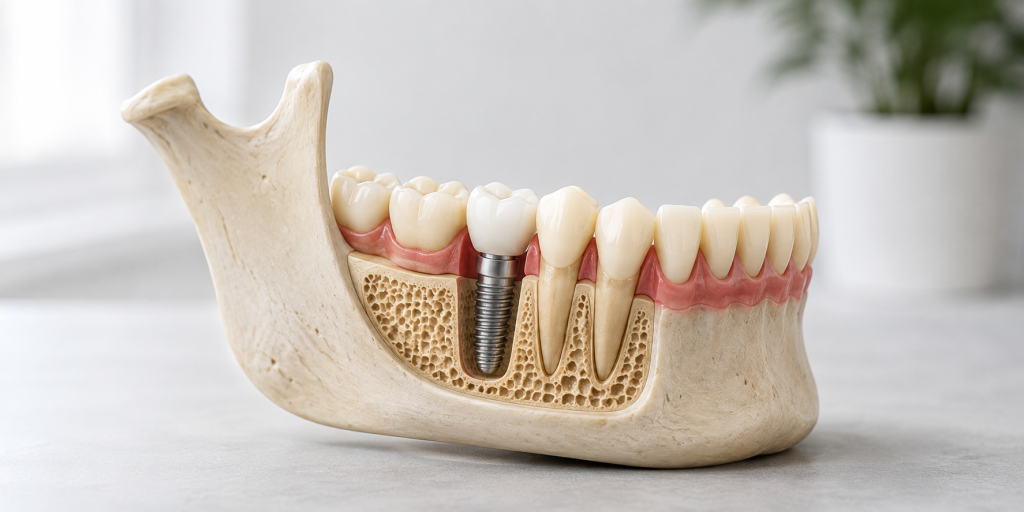
Mandible
Your lower jawbone. The part of your jaw that moves when you chew and speak. Lower jaw implants are placed into the mandible.
Bone resorption
The natural process by which the jawbone shrinks after teeth are lost. Without tooth roots stimulating the bone, the body gradually reabsorbs it. Long-term denture wearers often experience significant bone resorption over time.
Bone density
How thick and solid your jawbone is. Sufficient bone density is needed to anchor implants securely. Bone density is assessed via CBCT scan.
Terminal dentition
A clinical term meaning your remaining teeth are in such poor condition due to extensive decay, gum disease, or fracture, that they cannot be saved and require extraction.
Periodontitis
Advanced gum disease where infection has spread below the gum line and begun destroying the bone that supports your teeth. It is a leading cause of tooth loss and must be addressed before implant treatment proceeds.
Osseointegration
The process by which a dental implant fuses with the surrounding jawbone. Over 3–6 months, bone cells grow directly onto the titanium surface of the implant. Once osseointegration is complete, the implant is permanently anchored.
Procedure Names
All on 4
A full arch dental implant technique where a complete fixed bridge is supported by 4 implants — two placed straight at the front of the jaw and two placed at an angle at the back.
All on 6
The same concept as All on 4, but using 6 implants. Recommended in some cases for patients with lower bone density, heavier bite forces, or larger jaw dimensions. → Learn more: All on 4 vs All on 6
All on X
A general term for the full arch implant concept — “X” meaning any number of implants (4, 5, 6, or more). Used in industry and educational content as a generic descriptor.
Full arch implants
also: full arch restoration
Any implant-supported replacement of all teeth in one jaw. All on 4 is one type of full arch restoration.
Teeth in a day
also: same-day teeth
You leave the clinic with fixed teeth on the same day as your procedure. A temporary bridge is attached before you go home.
Immediate loading
Placing a temporary prosthesis onto the implants on the day of surgery. This is what makes same-day teeth possible.
Overdenture
also: snap-on denture
A removable prosthesis that clips onto implants. Unlike All on 4 which is fixed, an overdenture can be removed by the patient. It is held in place by attachments rather than screws.
Full mouth rehabilitation
Treatment involving both arches (upper and lower), either simultaneously or staged.
Implant Components
Implant fixture
also: implant post
The titanium screw that is surgically placed into the jawbone. It functions as an artificial tooth root. Over time, bone grows onto and around the implant surface in the process of osseointegration.
Abutment
A connector piece that sits on top of the implant fixture, above the gum line. The prosthesis is then attached to the abutment.
Titanium
A biocompatible metal used for implant fixtures and some prosthetic frameworks. Titanium is strong, lightweight, and well-tolerated by the human body. It is the standard material for dental implant posts worldwide.
Implant platform
The interface where the implant fixture and abutment connect. The platform size affects which abutment components are compatible.
Primary stability
How firmly an implant is anchored in bone immediately after placement, before healing begins. High primary stability is required for immediate loading (same-day teeth).
The Surgical Process
CBCT scan
Cone Beam CT
A 3D X-ray of your jaw. Unlike a standard dental X-ray, a CBCT shows bone volume, bone density, nerve location, and sinus anatomy in three dimensions. It is essential for All on 4 treatment planning and cannot be substituted with a 2D X-ray.
OPG
panoramic X-ray
A flat, wide-format dental X-ray showing all teeth and both jaws in one image. Useful for an overview of dental health but does not provide the 3D detail needed for implant planning.
Intraoral scan
A digital scan taken with a small wand-shaped camera placed inside the mouth. Produces a 3D digital model of your teeth and gums. Used for treatment planning and prosthesis design. Replaces the older method of taking physical impressions with putty.
Surgical guide
A custom-made template that fits over your gums or remaining teeth and directs the surgeon to place implants at precisely the planned positions and angles. Made from your CBCT data. Improves accuracy and reduces surgical risk.
Tilted implants
In the All on 4 technique, the two rear implants are placed at an angle rather than vertically. This allows them to engage more bone, avoid the sinus in the upper jaw, and achieve better primary stability — without bone grafting in many cases.
Bone grafting
Adding bone material to an area of bone loss to build volume for implant placement. The graft may come from the patient’s own body, a donor, or a synthetic source.
Sinus lift
A procedure that adds bone beneath the sinus cavity to create enough depth for upper jaw implants. All on 4 often avoids this entirely by using angled implants that work around the sinus.
Zygomatic implants
Extra-long implants anchored into the zygomatic (cheek) bone rather than the jaw. Used in cases of severe upper jaw bone loss where conventional implants are not possible.
Peri-implantitis
Infection in the tissue surrounding a dental implant, similar to gum disease around a natural tooth. If left untreated, it can lead to implant failure.
Your Temporary & Final Teeth
Provisional prosthesis
also: temporary bridge
The set of teeth fitted on the day of your procedure. Made from acrylic or PMMA. Designed to restore function and appearance during the osseointegration period.
Final prosthesis
also: permanent bridge
The long-term set of teeth fitted after osseointegration is confirmed, typically 3–6 months after surgery. Made from a more durable material such as milled zirconia or a titanium hybrid.
Smile design
also: digital smile design
The process of planning the shape, size, and colour of your new teeth before your procedure. Conducted using digital software, often allowing you to preview your result before treatment.
Occlusion
The way your upper and lower teeth meet when you bite. Correct occlusion distributes bite forces evenly and is an important consideration in full arch prosthesis design.
Implant Materials
Zirconia
A strong white ceramic material used for dental crowns, bridges, and full arch prostheses. → Full guide to prosthesis materials
Acrylic / PMMA
polymethyl methacrylate
A tooth-coloured plastic material commonly used for provisional (temporary) bridges.
Titanium bar
also: titanium framework
A milled metal scaffold inside a hybrid prosthesis. Acrylic or ceramic teeth are built over the titanium bar.
Hybrid prosthesis
A prosthesis combining a metal framework (titanium) with acrylic or porcelain teeth layered on top.
Milled bridge
A bridge carved by a computer-controlled milling machine from a solid block of material. Produces highly accurate, consistent results.
Written by Dr Chin Kent Boon
July 13 2026
All on X treatments at Kita Dental are led by Dr Kent, Principal Dentist and Implantologist, who holds a Master of Oral Implantology. Kita Dental is a dental clinic located in Mascot, NSW, with a strong focus on dental implants.
This article is general information only and is not a substitute for personalised advice from a registered dental practitioner. Outcomes vary from patient to patient.