All on 4 Cost in Sydney, Australia: What to Expect
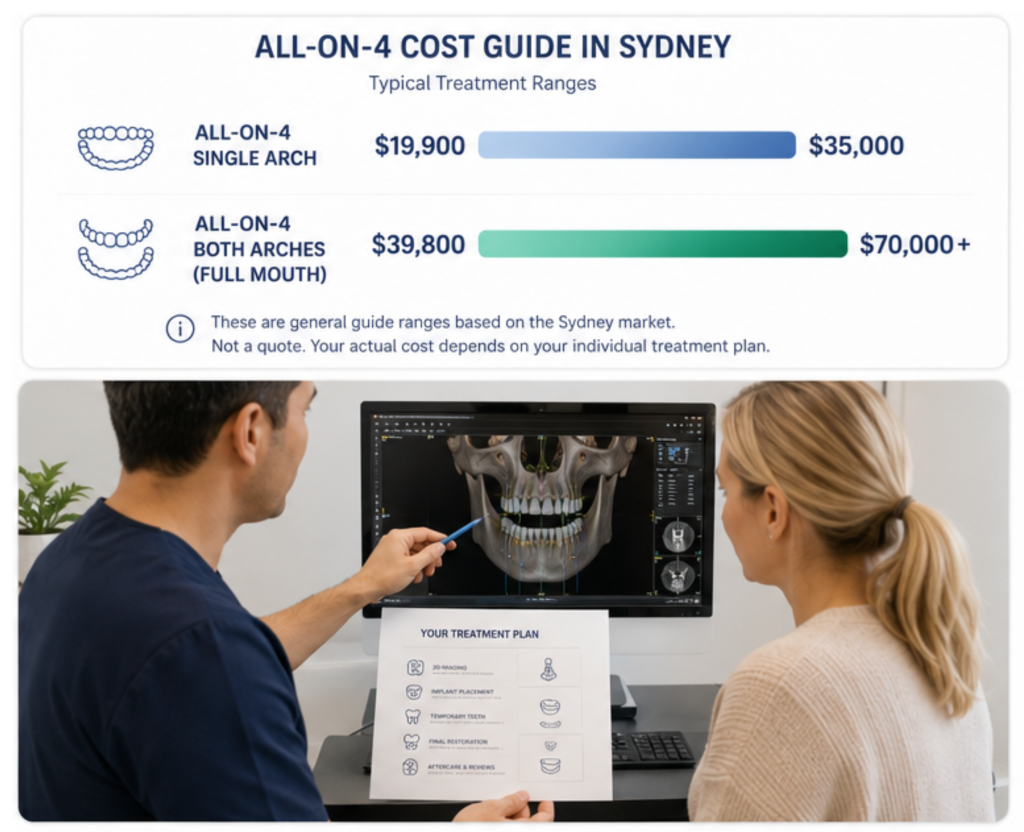
All on 4 typically costs around $19,900 to $35,000 per arch in Sydney, with some clinics quoting up to around $45,000 per arch for fully inclusive, premium treatment. Treating both arches (a full upper and lower restoration) generally totals around $39,800 to $70,000, and can run higher for premium materials. These are realistic ranges, not a fixed price — the actual cost for you depends on your individual treatment plan, the materials used, and whether any additional procedures are needed. This guide explains what’s behind the range and how to get an accurate quote for your own situation.
Why is there such a wide price range?
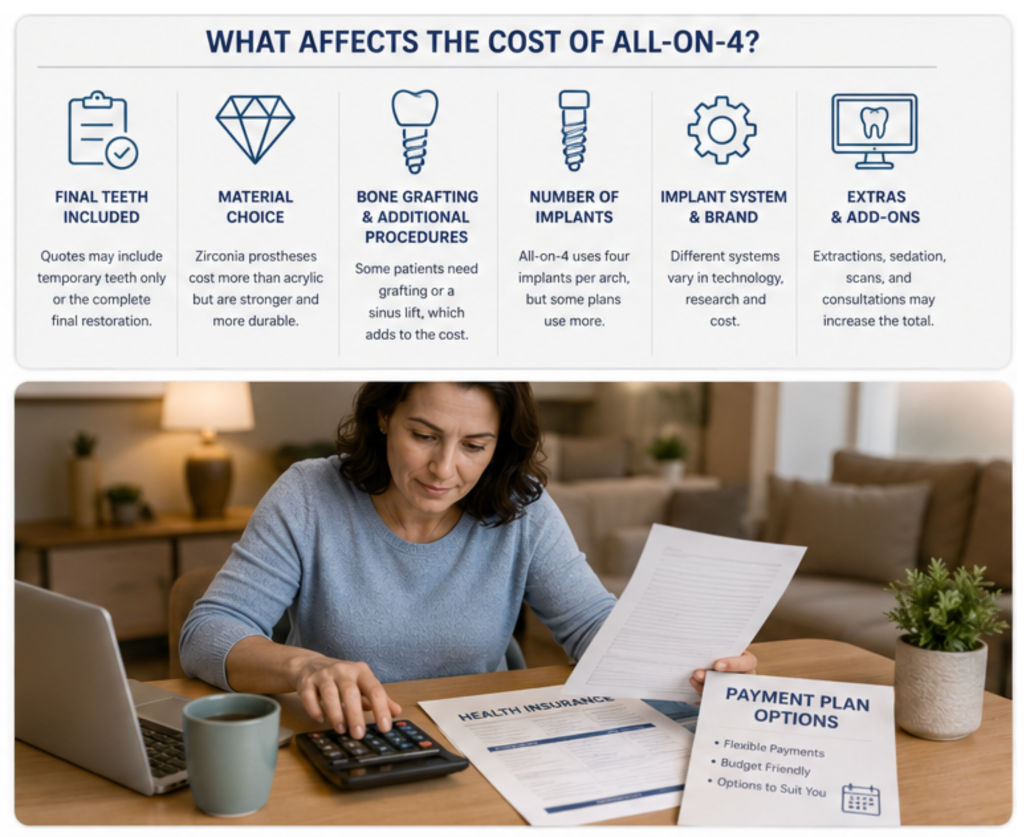
All on 4 pricing varies more than many people expect, because the final figure depends on several factors specific to your treatment, not just on which clinic you choose. The main reasons two quotes for “All on 4” can differ by tens of thousands of dollars include:
- Whether the quote includes the final teeth. Some advertised prices cover only the surgery and a temporary prosthesis (set of teeth), with the final, custom-made prosthesis added later as a separate cost. Always ask whether the quote is for the complete treatment, start to finish.
- The material used for the final teeth. A prosthesis made from acrylic on a metal framework generally costs less but also typically has a shorter lifespan and may need replacing sooner. A zirconia prosthesis costs more but is generally stronger and more stain-resistant.
- Whether bone grafting is needed. Some people need additional bone grafting or a sinus lift before or during implant placement, which adds to the cost. Others don’t, particularly because the angled implant design of All on 4 is intended to make use of available bone.
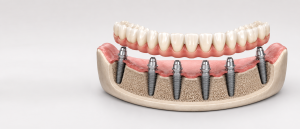
- The number of implants used. All on 4 uses four implants per arch, but some treatment plans use five or six, which changes the cost.
- The implant brand and system. Some implant systems cost more than others, reflecting differences in research, manufacturing and the clinical evidence behind them.
- Extractions, sedation, scans and consultations. If you need teeth removed first, or choose sedation, these typically add to the total.
Because of all this, the only reliable way to know your own cost is a personalised, itemised quote following an assessment.
What does the Australian Dental Association say about cost?
The Australian Dental Association (ADA) periodically runs a Dental Fees Survey, which is the closest thing to an independent national benchmark for dental fees in Australia. The ADA does not publish a single “All on 4 price” — full-arch treatment is made up of multiple individual items (implant placement, abutments, the prosthesis, and so on), each with its own fee. This is one reason it’s worth asking your dentist for an itemised quote that lists the relevant item numbers, so you can understand exactly what you’re being charged for and, if relevant, check it against your health fund.
A realistic price guide
While every treatment plan is different, here is a general guide to help you understand the ranges involved in the Sydney market:
Treatment | Typical range |
All on 4, single arch | $19,900–$35,000 |
All on 4, both arches (full mouth) | $39,800–$70,000+ |
These figures are a general guide based on the Sydney market and may not reflect every clinic or every case. They are not a quote, and your actual cost can only be confirmed after an assessment of your own teeth, bone and treatment needs.
Does insurance or Medicare cover the cost?
Medicare does not generally cover the cost of dental implant treatment. In some cases, where a specialist anaesthetist is involved, a Medicare rebate may be available for the anaesthetist’s services, as they are an independent health practitioner. Eligibility for any rebate is determined by Medicare based on the item numbers and individual circumstances.
Our team and anaesthetist will provide information about fees and any potential Medicare rebates prior to treatment.
Private health insurance may contribute a partial rebate if your policy includes “major dental” extras cover, which is where implants typically sit. However, the rebate may not cover the entire expense of a full-arch procedure, and:
- Major dental commonly has a waiting period, often around 12 months, before you can claim.
- Most policies have an annual limit for major dental that is well below the cost of All on 4.
- The rebate is based on your fund’s own schedule, not the clinic’s fee, so even a generous-sounding percentage often translates to a modest dollar amount.
The best approach is to get an itemised quote from your dentist with the relevant item numbers, and check directly with your health fund what you’re entitled to claim and when.
Payment plans and other ways to make treatment more accessible
If the upfront cost is a barrier, there are a few ways to make it more manageable:
- Payment plans. At Kita Dental, payment plans are available through Humm, a third-party finance provider, allowing eligible patients to spread the cost over time. Approval and terms are set by Humm, and it’s worth considering whether the repayments comfortably fit your budget.
- Health fund rebates, where applicable, as outlined above.
- Early release of superannuation. In eligible circumstances, the Australian Taxation Office (ATO) allows early access to some superannuation on compassionate grounds for certain dental treatment that meets strict criteria, including that it isn’t readily available through the public system.
Why the cheapest quote isn’t always the best comparison
A very low advertised price is worth looking at closely. It may reflect:
- A quote for the temporary bridge only, with the final bridge costed separately.
- A more basic bridge material.
- Fewer included scans, reviews or aftercare.
- A treatment plan that hasn’t yet accounted for extractions or bone grafting you may need.
Comparing clinics on the total, itemised cost for the complete treatment, not the headline number, gives a much more accurate picture, and helps you avoid surprise costs later in treatment.
How to get an accurate quote for your own case
The only way to know your actual cost is a consultation that includes:
- An oral examination and discussion of your goals and history.
- 3D imaging (CBCT) to assess your bone and plan treatment.
- A written, itemised treatment plan that states clearly what’s included — the implants, the temporary teeth, the final bridge, scans, reviews and any additional procedures like grafting.
This lets you compare quotes properly and budget with confidence.
This article is general information only, based on publicly available pricing information current as at the time of writing, and is not a quote or a substitute for personalised advice from a registered dental practitioner. Prices change over time and vary between providers and individual cases. This is not financial advice. Outcomes vary from patient to patient.
References
- Dental Board of Australia / AHPRA — Guidelines for advertising a regulated health service. ahpra.gov.au
- Australian Dental Association — Dental Fees Survey (most recently confirmed public edition: 2022). ada.org.au
- healthdirect (Australian Government) — Dental implants. healthdirect.gov.au
- Australian Taxation Office — Early access to superannuation on compassionate grounds, including eligible expenses and required documentation. ato.gov.au
- AHPRA / ATO joint statement (16 October 2025) on early superannuation release for dental treatment. ahpra.gov.au / ato.gov.au
- privatehealth.gov.au — comparing private health insurance extras and dental cover.
Written by Dr Chin Kent Boon
15 June 2026
All on X treatments at Kita Dental are led by Dr Kent, Principal Dentist and Implantologist, who holds a Master of Oral Implantology. Kita Dental is a dental clinic located in Mascot, NSW, with a strong focus on dental implants.
This article is general information only and is not a substitute for personalised advice from a registered dental practitioner. Outcomes vary from patient to patient.