All on 6 Dental Implants Explained: Benefits, Process and What to Expect
All on 6 dental implants replace a full arch of missing or failing teeth using six titanium implants per jaw to support a fixed bridge of replacement teeth. The implants act as artificial tooth roots and, once healed, hold the bridge firmly in place so it does not need to be removed for cleaning. This guide explains how All on 6 works, how it compares to All on 4, who it may suit, and what the process and aftercare involve.
What are All on 6 dental implants?
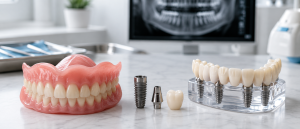
All on 6 is a method of full-arch tooth replacement. Six titanium implants are placed into the jawbone in a single arch (upper or lower), positioned to make good use of the available bone. Over the following months the implants fuse with the bone through a natural process called osseointegration, forming a stable foundation. A fixed bridge of teeth is then attached to the implants.
Because the bridge is fixed to the implants rather than resting on the gums, it stays in place and is only removed by your dentist. Like other dental implant treatments, All on 6 also transmits chewing forces into the jaw, which can help reduce the bone loss that tends to follow tooth loss.
Key benefits of All on 6
All on 6 can offer several benefits for people with extensive tooth loss or failing dentures:
- Fixed, stable teeth. The bridge is secured to the implants, so there are no adhesives and nothing to take out at night.
- Restored chewing and speaking. Many patients find a fixed, implant-supported bridge more stable than a removable denture, which can make eating and speaking feel more comfortable.
- Help preserving the jawbone. By transmitting bite forces into the bone, implants can help slow the bone loss that often follows missing teeth, supporting facial structure over time.
- Custom-made appearance. The bridge is designed to suit your bite and facial features for a natural-looking result.
- Designed to be long-lasting. With good oral hygiene and regular reviews, dental implants are intended as a long-term solution, though outcomes vary between individuals and the bridge itself may need maintenance or replacement over the years.
All on 6 vs All on 4: what’s the difference?
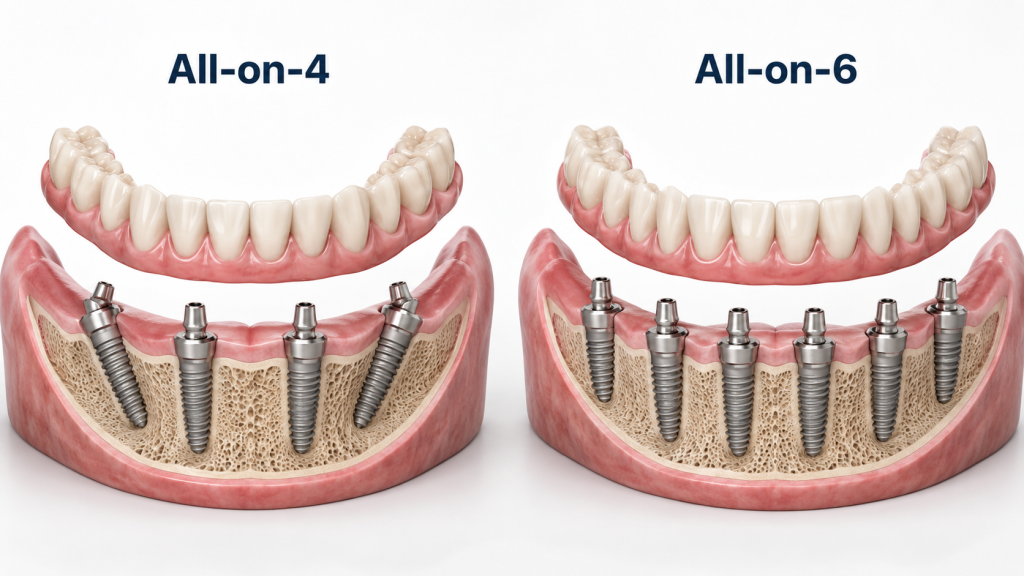
The main difference is in the number of implants — six instead of four, and there is no single option that is “better” for everyone. Which is appropriate depends on your individual anatomy and is decided after a clinical assessment.
- Number of support points. All on 6 uses two additional implants, giving more points of support for the bridge and spreading the chewing load across more implants.
- Bone requirements. All on 6 generally requires more available bone than All on 4. Where bone is more limited, All on 4 — which often uses angled implants to make the most of existing bone — may be more suitable, sometimes avoiding the need for grafting.
- Case selection. The right number of implants depends on factors such as your bone volume and density, your bite, the position of nerves and sinuses, and your overall goals.
Both approaches are well-established methods of full-arch restoration. During your consultation at Kita Dental, your bone and anatomy are assessed to work out which approach fits your situation.
The All on 6 process, step by step
- Consultation and planning. Your dentist discusses your goals, examines your mouth, reviews your medical history and takes a 3D cone beam CT (CBCT) scan. This shows bone density and the position of nerves and sinuses, and is used to plan where each implant can be safely placed.
- Surgery. The procedure is carried out under local anaesthetic, with sedation available for anxious patients. Any remaining failing teeth in the arch are removed, and the six implants are placed according to the plan. If there is not enough bone in a particular area, a bone graft may be recommended before or during placement.
- Same-day temporary teeth. In most cases a fixed set of temporary teeth is attached on the day, so you leave with teeth in place. These are not the final result.
- Healing (osseointegration). Over the next few months the implants integrate with the bone. During this time you follow a softer diet and wear the temporary bridge while attending review appointments.
- Fitting your final teeth. Once the implants are confirmed to be stable, the temporary bridge is replaced with your final, custom-made set of teeth.
Caring for All on 6 implants
Implant-supported teeth need daily care, much like natural teeth, plus a few extra techniques for cleaning around a fixed bridge:
- Brush gently with a soft-bristled toothbrush, paying attention to where the bridge meets the gum.
- Clean underneath and around the bridge using interdental brushes, super floss or a water flosser, as shown by your dental team.
- Attend regular professional check-ups and cleans so your dentist can monitor the implants, bridge, gums and bone.
Good hygiene matters because poor cleaning can lead to peri-implantitis (inflammation) around the implants that can cause bone loss if left untreated. Consistent home care and regular reviews are the best way to protect the result.
What affects the cost of All on 6?
The cost of All on 6 depends on factors such as whether one or both arches are treated, the materials used for the final bridge, whether any groundwork (like extractions or bone grafting) is needed, and the complexity of your case. Treatment with a functional or restorative benefit may attract a rebate under “major dental” health-fund cover — limits and waiting periods vary, so check with your fund. In limited eligible circumstances, early release of superannuation on compassionate grounds, assessed by the Australian Taxation Office (ATO), may also be an option. A detailed, itemised quote at your consultation is the best way to understand the cost for you.
References
- Dental Board of Australia / AHPRA — Guidelines for advertising a regulated health service. ahpra.gov.au
- Australian Dental Association — patient information on dental implants. ada.org.au
- healthdirect (Australian Government) — Dental implants. healthdirect.gov.au
- Australian Taxation Office — Early access to superannuation on compassionate grounds. ato.gov.au
- Zhang Y, Li S, Di P, Zhang Y, Wu A, Lin Y. Comparison of 4- or 6-implant supported immediate full-arch fixed prostheses: A retrospective cohort study of 217 patients followed up for 3-13 years. Clin Implant Dent Relat Res. 2023 Apr;25(2):381-397. doi: 10.1111/cid.13170. Epub 2022 Dec 15. PMID: 36522852.
Written by Dr Chin Kent Boon
2 June 2026
All on X treatments at Kita Dental are led by Dr Kent, Principal Dentist and Implantologist, who holds a Master of Oral Implantology. Kita Dental is a dental clinic located in Mascot, NSW, with a strong focus on dental implants.
This article is general information only and is not a substitute for personalised advice from a registered dental practitioner. Outcomes vary from patient to patient.