10 Facts About All on 4 You Probably Didn’t Know
If you already know the basics of All on 4 and want the detail behind it, here’s what’s actually going on.
New to All on 4 altogether? Our All on 4 guide covers the fundamentals, candidacy, and full process.
1.The back implants are deliberately placed at an angle
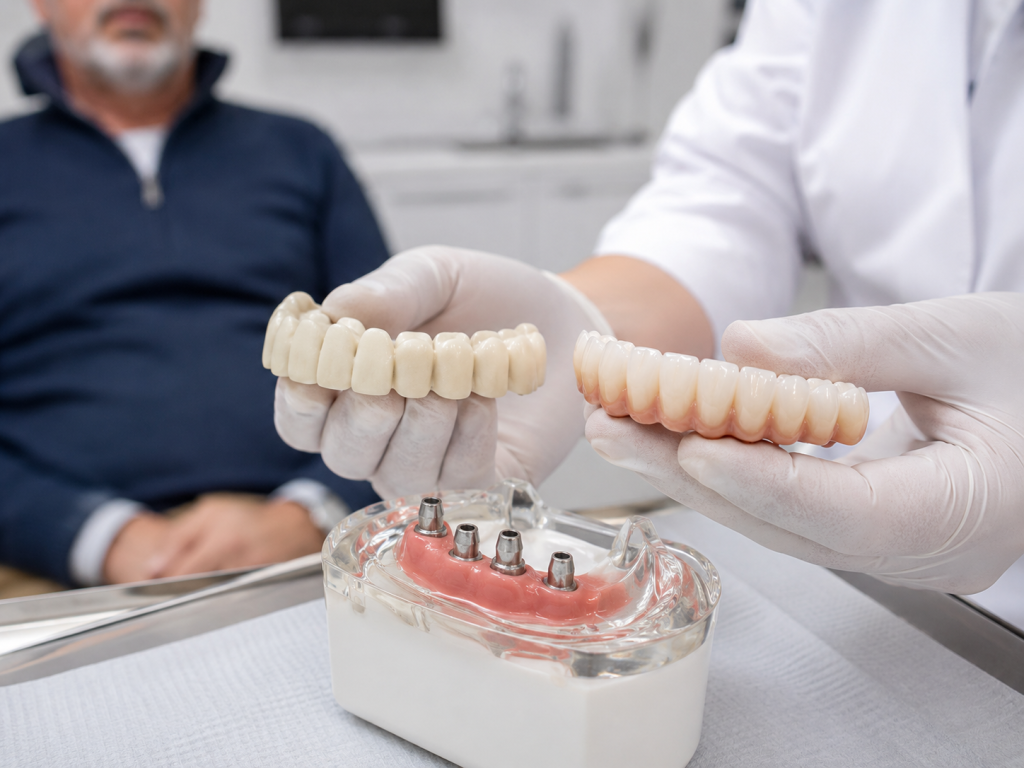
All on 4 replaces a whole arch using just four implants, not one per missing tooth, and how those four are positioned is the defining feature of the approach. The two front implants sit relatively upright, while the two back implants are tilted, typically around 30 to 45 degrees. Angling them lets the implants anchor into denser, more available bone, and avoid structures such as the sinuses in the upper jaw and the nerve in the lower jaw.
2. The angled design can often avoid bone grafting
Because the tilted back implants make use of bone that’s already there, All on 4 can sometimes avoid the bone grafting that other approaches might require when bone is limited. Whether grafting is needed still depends on your individual anatomy, which is assessed with a 3D scan.
4. The concept has been around since the 1990s
All on 4 isn’t brand new. It was introduced by Portuguese implantologist Dr Paulo Maló, and since its publication, the technique has been extensively studied and refined[1].
5. The teeth you get on surgery day are temporary
A common misconception is that you walk out with your final teeth the same day. In most cases a fixed set of temporary teeth is attached on the day of surgery, but the final, custom-made teeth are fitted later, after the implants have healed and fused with the bone, which usually takes several months.
6. Implants help slow jawbone loss
When teeth are lost, the jawbone that supported them tends to shrink over time. Because implants transmit chewing forces into the bone, they can help slow this bone loss in the treated area, unlike removable dentures, which rest on the gums.
7. An upper All on 4 bridge doesn’t cover the roof of your mouth
Unlike a full upper denture, which covers the palate, an All on 4 bridge leaves the roof of the mouth uncovered. Many people find this more comfortable and notice it can help with the sensation of taste and temperature when eating.
8. It’s still surgery and it isn’t for everyone
All on 4 is a surgical procedure and, like any surgery, carries risks such as infection, swelling, and the possibility of an implant not integrating. It also isn’t suitable for everyone: factors such as the amount of available bone, gum health, smoking and general health all affect whether it’s a sensible option. A thorough assessment is used to work this out beforehand.
9. It works through a natural process called osseointegration
The implants are made of titanium, which the body generally tolerates well. Over the months after surgery, the jawbone grows around and fuses with the implants, this process is called osseointegration. This is what gives the implants their long-term stability, and is the reason healing takes time rather than happening overnight.
10.The implants are placed using detailed 3D planning, not guesswork
Before surgery, a 3D CBCT scan maps the exact shape, density, and volume of your jawbone. This planning is what allows the back implants to be angled precisely enough to avoid the sinuses or nerve while still anchoring into solid bone. In many cases, this planning is translated into a custom template which helps position each implant exactly where it was planned, so the positions used on surgery day are the result of detailed digital mapping rather than being decided on the spot.
Written by Dr Kent Boon
9 September 2026
All on X treatments at Kita Dental are led by Dr Kent, Principal Dentist and Implantologist, who holds a Master of Oral Implantology. Kita Dental is a dental clinic located in Mascot, NSW, with a strong focus on dental implants.
This article is general information only and is not a substitute for personalised advice from a registered dental practitioner. Outcomes vary from patient to patient.
References
[1] Malo P, Rangert B, Nobre M. “All-on-4” immediate-function concept with zygomatic implants for the rehabilitation of the severely atrophic maxilla: a preliminary prospective study. Clin Implant Dent Relat Res. 2003;5(Suppl 1):2-9.
[2] Dental Board of Australia / AHPRA Guidelines for advertising a regulated health service. ahpra.gov.au
[3] Australian Dental Association: Patient information on dental implants. ada.org.au
[4] Healthdirect (Australian Government): Dental implants. healthdirect.gov.au