Can You Get All on 4 With Severe Bone Loss? Bone Grafting Explained
In many cases, yes — but it depends on how much bone you have. All on 4 is specifically designed to make the most of available bone by angling the back implants, which means it can often avoid bone grafting even when there has been some bone loss. With severe bone loss, your options may include bone grafting to rebuild the bone first, alternative techniques such as zygomatic implants, or sometimes a combination, and in some situations a different approach is recommended altogether. The only way to know what’s possible for you is a 3D assessment of your jaw. This guide explains how it all fits together.
Why does bone loss happen?
The jawbone needs stimulation from teeth to maintain its volume. When teeth are lost, the bone that supported them gradually shrinks, a process called resorption. The longer teeth have been missing, the more bone tends to be lost. Gum disease, long-term denture wearing, infections and previous extractions can all contribute. This is why people who have worn dentures for many years, or who have had missing teeth for a long time, often have reduced bone in the jaw.
How All on 4 is designed to handle bone loss
A key feature of All on 4 is that the two back implants are placed at an angle rather than straight down. This lets them anchor into areas where more bone is naturally available towards the front of the jaw and away from structures like the sinuses and nerves. Because of this design, All on 4 can often be carried out without bone grafting in cases of moderate bone loss that might otherwise require it. This is one of the reasons the technique is popular for full-arch restoration.
What about severe bone loss?
If bone loss is severe, the angled design alone may not provide enough support, and additional steps may be needed. Depending on your anatomy, the options generally include:
- Bone grafting to rebuild or augment the bone before or during implant placement.
- Zygomatic implants, which anchor into the cheekbone rather than the jaw and are designed specifically for severe upper-jaw bone loss — often avoiding extensive grafting.
- A combination of conventional and zygomatic implants.
In some cases, a careful assessment may conclude that a different treatment is more appropriate for you. An honest assessment is the point of the consultation, not every jaw is suited to every technique.
What is bone grafting?
Bone grafting is a procedure that adds or rebuilds bone where it has been lost, creating enough volume to support implants. There are several types, used depending on where and how much bone is needed:
- Socket preservation — bone is placed into the socket at the time a tooth is removed, to limit the bone loss that follows.
- Ridge augmentation — rebuilding width or height along the jaw ridge where bone has shrunk.
- Sinus lift (sinus augmentation) — in the upper back jaw, the floor of the sinus is gently lifted and bone added beneath it, where the sinus has expanded into space once occupied by tooth roots.
The grafting material itself may come from your own body, from a processed donor or animal source, or from a synthetic substitute. Your dentist will explain which approach suits your situation.
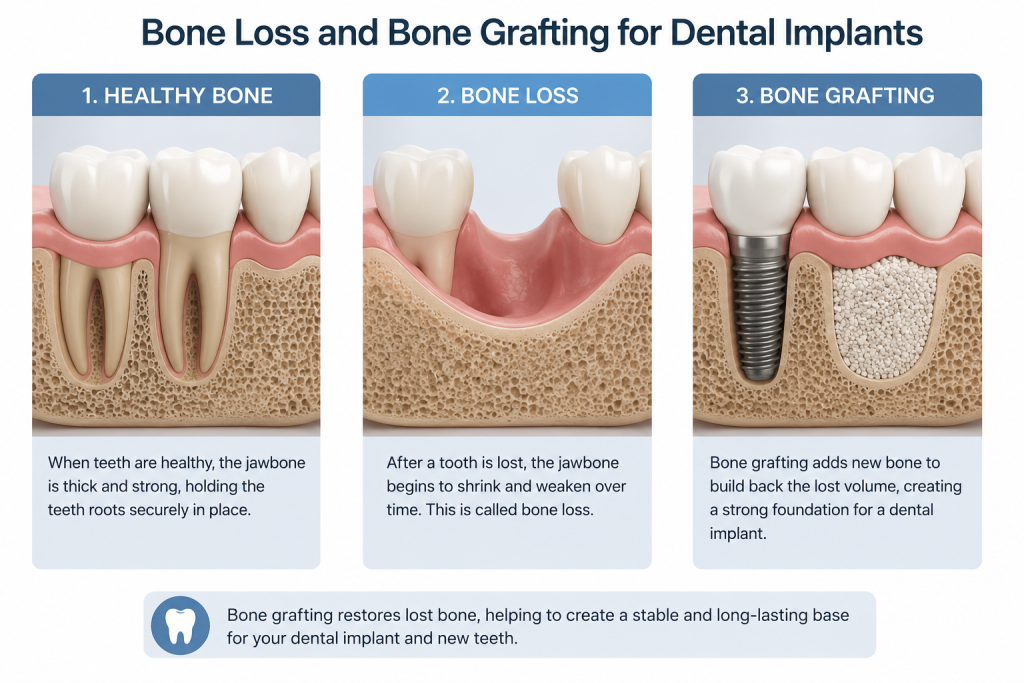
The grafting process and timeline
Bone grafting adds time to the overall treatment. After a graft is placed, it usually needs several months to mature and integrate before implants can be placed into it (though in some cases grafting and implant placement happen together). This means treatment involving grafting generally takes longer from start to finish than treatment that avoids it, one of the reasons techniques that reduce the need for grafting, like angled or zygomatic implants, are often considered first where appropriate.
Risks and considerations of bone grafting
Like any surgical procedure, bone grafting carries risks, including infection, swelling, and the possibility that the graft doesn’t integrate as hoped, which may mean repeating the procedure. Sinus-related complications can occur with a sinus lift. Your dentist will assess and explain the risks relevant to your case. As with all treatments, outcomes vary between individuals.
How it’s assessed
Whether you need grafting, and which approach suits you, is determined by a detailed assessment including a 3D cone beam CT (CBCT) scan. This shows exactly how much bone you have, its quality, and where it is, allowing your dentist to plan whether All on 4 is possible as is, whether grafting is needed, or whether an alternative such as zygomatic implants would be more suitable.
References
- Dental Board of Australia / AHPRA — Guidelines for advertising a regulated health service. ahpra.gov.au
- Australian Dental Association — patient information on dental implants and bone grafting. ada.org.au
- healthdirect (Australian Government) — Dental implants. healthdirect.gov.au
- Patzelt SB, Bahat O, Reynolds MA, Strub JR. The all-on-four treatment concept: a systematic review. Clin Implant Dent Relat Res. 2014 Dec;16(6):836-55. doi: 10.1111/cid.12068. Epub 2013 Apr 5. PMID: 23560986.
Written by Dr Chin Kent Boon
26 February 2026
All on X treatments at Kita Dental are led by Dr Kent, Principal Dentist and Implantologist, who holds a Master of Oral Implantology. Kita Dental is a dental clinic located in Mascot, NSW, with a strong focus on dental implants.
This article is general information only and is not a substitute for personalised advice from a registered dental practitioner. Outcomes vary from patient to patient.