Dental Implants: Risks and Benefits Explained
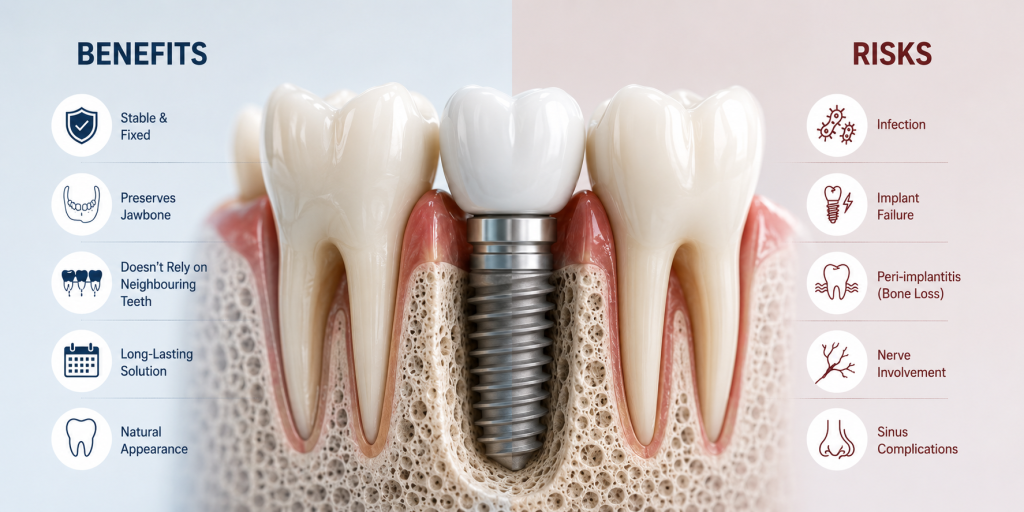
Dental implants can restore the function and appearance of missing teeth and are designed to be a long-lasting solution, but like any surgical treatment they carry risks. The main benefits include stable, fixed replacement teeth, preservation of jawbone, and not relying on neighbouring teeth for support. The main risks include infection, implant failure, and, less commonly, nerve or sinus involvement. This guide explains both sides honestly so you can weigh them up.
What are dental implants?
A dental implant is a small titanium post that is placed into the jawbone to act as an artificial tooth root. Once it fuses with the bone, it can support a single crown, a bridge, or a full arch of teeth such as an All on 4 restoration. Implants are one of several ways to replace missing teeth; the alternatives being dentures and conventional bridges, and they suit some people better than others.
The benefits of dental implants
They are fixed and stable. Unlike removable dentures, an implant-supported tooth or bridge stays in place. Many patients find this makes eating and speaking feel more natural and secure.
They help preserve jawbone. When a tooth is lost, the bone that supported it tends to shrink over time. Because an implant transmits chewing forces into the bone, it can help slow this bone loss in the area — something dentures sitting on the gum do not do in the same way.
They don’t rely on neighbouring teeth. A conventional bridge usually involves trimming down the healthy teeth on either side of a gap. A single implant replaces the missing tooth on its own, leaving the adjacent teeth untouched.
They are designed to be long-lasting. With good oral hygiene and regular dental reviews, implants are intended as a long-term solution. Published research reports high long-term success rates, though outcomes vary between individuals and depend on care and health factors.
They can support a natural-looking result. The crown or bridge attached to an implant is custom-made to match your other teeth and your bite.
The risks of dental implants
Being clear about what can go wrong is part of making an informed decision. Risks and complications include:
- Infection at the implant site, either soon after surgery or later.
- Implant failure — the implant may not fuse properly with the bone (failure to integrate), or may loosen over time. If this happens, the implant may need to be removed and the site allowed to heal.
- Peri-implantitis — an inflammatory condition affecting the gum and bone around an implant, often linked to plaque build-up, which can lead to bone loss if untreated.
- Nerve involvement — in the lower jaw, implants placed near a nerve can, in rare cases, cause tingling, numbness or altered sensation in the lip, chin or gum.
- Sinus complications — in the upper jaw, implants near the sinus cavity can occasionally affect it.
- Bleeding, swelling and bruising — common in the short term after surgery and usually temporary.
- Damage to nearby teeth or surrounding structures during placement.
- The need for additional procedures — for example, bone grafting or a sinus lift if there is not enough bone to support an implant.
Most of these are uncommon and many are manageable, but they are real possibilities that should be discussed before treatment.
Are dental implants safe?
Dental implants are a well-established treatment that has been used for decades, and they are generally considered safe when placed by a trained clinician after proper assessment. As with any surgery, they carry risks, and success is not guaranteed for every person. A thorough examination including 3D imaging and a review of your medical history is used to identify risks in advance and plan treatment as safely as possible.
What affects the success of an implant?
Several factors influence how well an implant heals and lasts:
- Bone quality and quantity at the implant site.
- Oral hygiene — implants need the same daily care and professional cleaning as natural teeth.
- Smoking, which is associated with higher rates of implant complications and failure.
- General health, including conditions such as poorly controlled diabetes.
- Gum health — active gum disease is usually treated before implants are placed.
Because of this, implants are not automatically suitable for everyone, and part of the assessment is working out whether they are a sensible option for you.
How are the risks reduced?
Risk cannot be removed entirely, but it can be lowered. This typically involves detailed planning with 3D (CBCT) imaging to map bone, nerves and sinuses; treating any gum disease or infection first; placing implants where the bone is most able to support them; and giving clear aftercare instructions. Ongoing reviews and good home care then help protect the implant over the long term.
A note on cost and time
Implants are an investment of both money and time. The process usually spans several months from placement to final teeth, because the implant needs time to fuse with the bone. In Australia, dental implant treatment is generally not covered by Medicare for most adults, though some private health funds with “extras” cover may contribute a portion. It is worth confirming any rebate with your own fund.
References
- Dental Board of Australia / AHPRA — Guidelines for advertising a regulated health service. ahpra.gov.au
- Australian Dental Association — patient information on dental implants. ada.org.au
- healthdirect (Australian Government) — Dental implants. healthdirect.gov.au
- Gupta R, Gupta N, Weber, DDS KK. Dental Implants. 2023 Aug 8. In: StatPearls [Internet]. Treasure Island (FL): StatPearls Publishing; 2026 Jan–. PMID: 29262027.
Written by Dr Chin Kent Boon
1 April 2026
All on X treatments at Kita Dental are led by Dr Kent, Principal Dentist and Implantologist, who holds a Master of Oral Implantology. Kita Dental is a dental clinic located in Mascot, NSW, with a strong focus on dental implants.
This article is general information only and is not a substitute for personalised advice from a registered dental practitioner. Outcomes vary from patient to patient.